
Car Stereo Audio Quality & Specs: 13-Band EQ & FLAC Guide
Introduction: Let’s Talk About Sound
You know that feeling when you’re driving, your favorite song comes on, and everything just feels right? The bass hits clean. The vocals are crisp. You can hear the little details you never noticed before.
That’s audio quality & specs doing their magic.
Here’s the thing: most people think any new stereo will sound better than their old factory unit. And sure, that’s often true. But if you really want to transform your driving experience—if you want to feel like you’re sitting in a concert instead of just listening to music on the road—you need to understand what’s actually happening under the hood.
We’re talking about things like car stereo with 13 band equalizer systems, flac playback car stereo compatibility, mosfet amplifier car stereo technology, and time alignment car stereo features. I know those sound like technical jargon, but trust me—by the time you finish this guide, you’ll know exactly what each one does and why it matters for your daily drive.
Whether you’re a casual listener who just wants clear phone calls or an audiophile who demands reference-quality sound, this guide will help you pick a bluetooth car stereo that delivers.
And if you haven’t already, check out our Cluster 1 guide for the best stereo models on the market, our Cluster 2 installation guide for wiring and setup tips, and our Cluster 3 hands-free safety guide to make sure you’re driving smart. Now, let’s dive into the good stuff—the sound.
Why Audio Quality Matters More Than You Think
Let me ask you something.
Have you ever bought a new stereo, installed it, and felt… underwhelmed? The music plays, sure. But it’s flat. Lifeless. The bass sounds like someone tapping on a cardboard box.
That happens when you ignore audio quality & specs.
Your car is one of the worst possible environments for good sound. Glass reflects sound waves. Carpets absorb them. Seats block them. Road noise, engine rumble, wind—it’s all fighting against you.
A quality bluetooth car stereo with the right specifications fights back.
Here’s what good audio quality gives you:
1. Clarity: You hear every instrument, every vocal, every breath
2. Depth: The music feels three-dimensional, not flat
3. Power: It fills the car without distortion, even at highway speeds
4. Precision: Bass is tight, treble is smooth, and nothing sounds harsh
The good news? You don’t need to spend a fortune. You just need to know what to look for.
The Equalizer: Your Secret Weapon for Perfect Sound
Let’s start with the most important feature you might be ignoring: the equalizer, or EQ for short.
An equalizer lets you adjust different frequency ranges independently. Think of it like a mixer board for your car. Want more bass? Turn up the low frequencies. Vocals getting lost? Boost the mids. Highs too harsh? Dial back the treble.
Preset EQs vs. Custom EQs
Most basic stereos come with preset EQs. You’ve seen them: “Rock,” “Pop,” “Jazz,” “Classical,” “Flat.” These are one-size-fits-all solutions that rarely fit anyone perfectly.
A car stereo with 13 band equalizer gives you 13 different frequency sliders to adjust. That’s 13 ways to fine-tune your sound to match your car, your speakers, and your ears.
| EQ Type | How Many Bands | Who It’s For |
|---|---|---|
| Basic Presets (Rock, Pop, etc.) | 3-5 bands (locked) | Casual listeners who want simple options |
| Basic Custom EQ | 5-7 bands | Most daily drivers |
| Good Custom EQ | 9-10 bands | Enthusiasts who want real control |
| Advanced Custom EQ | 13-16 bands | Audiophiles and serious music lovers |
If you’re shopping for a 16 band equalizer car audio system, you’re getting serious control. That’s enough to compensate for almost any acoustic issue in your vehicle.
How to Tune Your EQ (Without Being an Expert)
Here’s a simple process that works for almost any car:
- Start flat. Set all bands to zero.
- Play a song you know really well. Something with vocals, bass, and treble.
- Boost the bass slightly. Around 60-80Hz. Add just enough to feel it in your chest.
- Check the mids. Around 1kHz-3kHz. This is where vocals live. Boost slightly if voices sound distant.
- Adjust the highs. Around 10kHz-15kHz. Add a little sparkle, but don’t overdo it—too much sounds harsh.
- Listen in different seats. What sounds good in the driver’s seat might sound muddy in the back.
A car stereo with 13 band equalizer gives you the precision to fix problems that simpler EQs can’t touch. And if you’re pairing it with aftermarket speakers, proper tuning makes a massive difference.
Looking for stereos with advanced EQ features? Our Cluster 1 guide highlights the best models with 13-band and 16-band equalizers.
Amplifier Power: What 4x50W Actually Means
You’ve seen the numbers: “50W x 4 channels.” “Peak power: 200W.” “RMS: 22W x 4.”
What does any of that actually mean?
RMS vs. Peak Power (The Important Difference)
Here’s the truth that stereo companies don’t want you to know: peak power is mostly marketing fluff.
- Peak power: The maximum wattage the amplifier can produce for a split second before it distorts or damages itself. It’s basically a lie.
- RMS power (Root Mean Square): The actual, continuous power the amplifier can deliver all day long without breaking a sweat. This is the number that matters.
A 4x50w bluetooth car stereo with 50 watts RMS per channel is legitimately powerful. That will drive most aftermarket speakers beautifully and get plenty loud without distortion.
Here’s what different power levels feel like:
| RMS Power Per Channel | Real-World Experience |
|---|---|
| 10-15 watts | Factory stereos. Fine for talk radio, weak for music. |
| 18-22 watts | Most entry-level aftermarket stereos. Noticeably better than factory. |
| 25-35 watts | Good power. You’ll hear cleaner bass and clearer highs. |
| 40-50 watts | Excellent power. Drives most speakers to their full potential. |
| 50+ watts | Serious power. Usually requires an external amplifier. |
MOSFET Amplifiers (The Gold Standard)
You might see the term mosfet amplifier car stereo on spec sheets. MOSFET stands for Metal-Oxide-Semiconductor Field-Effect Transistor. Fancy name. Simple benefit: efficiency.
A mosfet amplifier car stereo runs cooler, uses less power from your car’s electrical system, and produces cleaner sound than older amplifier designs. Most quality aftermarket stereos use MOSFET amps for a reason—they just work better.
If you see a bluetooth car stereo advertising “MOSFET” anywhere in the specs, that’s a good sign. It means the manufacturer didn’t cut corners on the amplifier section.
Time Alignment: Making Sound Feel Three-Dimensional
Here’s a problem you might not have thought about.
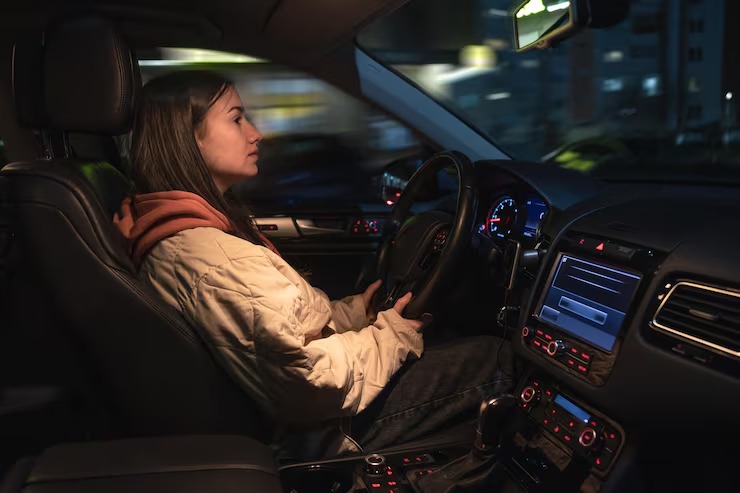
In your car, the speakers are all different distances from your ears. The left door speaker is close to you. The right door speaker is farther away. The rear speakers are behind you.
Sound travels at about 1 foot per millisecond. Those tiny distance differences mean sound reaches your ears at slightly different times. Your brain notices, even if you don’t consciously realize it. The result? The music sounds flat. Disconnected. Like the band is spread out instead of playing together.
Time alignment car stereo systems fix this.
How Time Alignment Works
A time alignment car stereo digitally delays the signal to speakers that are closer to you. That way, all the sound reaches your ears at the same moment—even though the speakers are different distances away.
The effect is magical. Suddenly, the vocals center themselves in front of you. The bass feels like it’s coming from everywhere at once. The soundstage feels wide and deep, like you’re listening to studio monitors instead of car speakers.
What time alignment does for you:
- Pulls the vocals to the center of the dashboard
- Creates a wider, deeper soundstage
- Makes rear speakers blend seamlessly with front speakers
- Reduces listening fatigue on long drives
Not every stereo has time alignment car stereo features. It’s usually found on higher-end models. But if you care about audio quality & specs, it’s worth the upgrade. Once you hear a properly time-aligned system, you’ll never want to go back.
High-Resolution Audio: FLAC Playback and Beyond
Let’s talk about the music itself.
Most people stream music from Spotify, Apple Music, or YouTube Music. Those services compress the audio to save bandwidth. The technical term is “lossy compression.” The practical effect? You lose detail. Cymbals sound fuzzy. Bass loses its punch. Vocals get slightly smeared.
A flac playback car stereo solves this problem.
What Is FLAC and Why Should You Care?
FLAC stands for Free Lossless Audio Codec. It’s a file format that preserves every single bit of audio information from the original recording. No compression. No loss of quality.
| File Type | Quality | File Size | Best For |
|---|---|---|---|
| MP3 (128kbps) | Poor | Very small | Podcasts, talk radio |
| MP3 (320kbps) | Okay | Small | Casual listening |
| AAC (Apple Music) | Good | Medium | Streaming on the go |
| FLAC (lossless) | Excellent | Large | Audiophiles, serious listening |
| WAV (uncompressed) | Perfect | Huge | Studio work, archiving |
A flac playback car stereo can read FLAC files from a USB drive or SD card. Fill that drive with your favorite albums in FLAC format, and you’ll hear details you never knew existed. The difference is especially noticeable on a good system with a mosfet amplifier car stereo and quality speakers.
Other High-Res Formats to Know
- ALAC (Apple Lossless): Apple’s version of FLAC. Works great if you’re in the Apple ecosystem.
- WAV: Uncompressed, massive files. Sounds perfect but takes up tons of space.
- DSD: Ultra-high-resolution format. Overkill for most cars, but some high-end stereos support it.
If you’re serious about audio quality & specs, look for a bluetooth car stereo that supports at least FLAC playback. Combined with a car stereo with 13 band equalizer and time alignment car stereo features, you’ll have a system that rivals home audio setups.
Want to know which stereo models support FLAC and high-res audio? Our Cluster 1 guide breaks down the specs of the top contenders.
Speaker-Level Specs: What Your Stereo Needs to Drive
Your stereo’s specifications need to match your speakers. Mismatch them, and you’ll get disappointing sound—or worse, damaged equipment.
Impedance (Measured in Ohms)
Most car speakers are 4-ohm. Some factory speakers are 2-ohm. A few high-end speakers are 8-ohm.
Your bluetooth car stereo is designed to work best with a specific impedance range. Most aftermarket stereos handle 4-8 ohms safely. If you connect 2-ohm speakers, the amplifier works harder, runs hotter, and might shut down or distort.
Quick rule: Stick with 4-ohm speakers unless you know exactly what you’re doing.
Sensitivity (Measured in dB)
Sensitivity tells you how efficiently a speaker converts power into volume.
| Sensitivity | What It Means |
|---|---|
| Under 88dB | Needs lots of power. Requires a strong external amp. |
| 88-92dB | Average efficiency. Works fine with most 4x50w bluetooth car stereo units. |
| 93dB and up | Very efficient. Gets loud with minimal power. Great for factory replacements. |
If you’re using the built-in amplifier of your bluetooth car stereo (instead of adding an external amp), choose speakers with sensitivity of 90dB or higher. They’ll sound louder and cleaner with the power your stereo provides.
Power Handling (Measured in Watts)
Speakers have two power ratings:
- RMS handling: The continuous power the speaker can handle without damage.
- Peak handling: The maximum short-term power the speaker can survive.
Match your stereo’s RMS output to your speaker’s RMS handling. If your 4x50w bluetooth car stereo puts out 50 watts RMS per channel, get speakers rated for 40-60 watts RMS. That’s the sweet spot.
Crossover Features: Separating Bass from Treble
A crossover is a filter that sends low frequencies to woofers and high frequencies to tweeters. Without a good crossover, your speakers try to play frequencies they weren’t designed for, resulting in muddy, distorted sound.
High-Pass Filters (HPF)
A high-pass filter blocks low frequencies from reaching your main speakers. Why would you want that? Because low frequencies require lots of power. Blocking them frees up your amplifier to focus on mids and highs, which means cleaner sound and more volume.
When to use HPF:
- You have a separate subwoofer (let the sub handle bass)
- Your door speakers distort when bass hits
- You want to play louder without distortion
Low-Pass Filters (LPF)
A low-pass filter does the opposite—it blocks high frequencies. You use LPF on subwoofers so they only play bass.
When to use LPF:
- You’ve added an external subwoofer
- Your rear speakers are playing bass but you want them to focus on mids
A quality bluetooth car stereo will have adjustable crossovers, usually around 50-200Hz. A car stereo with 13 band equalizer often includes crossover controls in the same menu, letting you fine-tune exactly which frequencies go where.
Putting It All Together: Building Your Ideal System
So you’ve read through all these specs. Your head might be spinning a little. Let me simplify.
Here’s how to choose a bluetooth car stereo based on your listening habits and budget.
The Casual Listener
You listen to: Radio, podcasts, background music You want: Clear calls, decent sound, no hassle
What to look for:
- 4x50w bluetooth car stereo with at least 22 watts RMS
- Basic 5-7 band EQ
- Built-in microphone (or external if you prefer)
- No need for FLAC or time alignment
Budget: $100-$200
The Enthusiast
You listen to: Your favorite albums, streaming playlists, some FLAC files You want: Great sound that makes you smile
What to look for:
- Car stereo with 13 band equalizer for fine-tuning
- Mosfet amplifier car stereo for clean power
- Flac playback car stereo capability
- External microphone for clear calls
Budget: $200-$400
The Audiophile
You listen to: Lossless audio, critical listening, live recordings You want: Reference-quality sound in your car
What to look for:
- 16 band equalizer car audio or better
- Time alignment car stereo features
- Mosfet amplifier car stereo with preamp outputs for external amps
- Flac playback car stereo plus support for other high-res formats
- External microphone with noise cancellation
Budget: $400-$800+
Installation Tips for Better Sound
Even the best bluetooth car stereo will sound mediocre if installed poorly. Here are a few quick tips.
Use quality wiring. Thin, cheap wire restricts power and degrades signal. Use at least 16-gauge wire for speakers.
Check your speaker polarity. If one speaker is wired backward (positive to negative), it will be out of phase. Bass disappears. Sound feels hollow. A car stereo with 13 band equalizer can’t fix phase issues—you have to wire them correctly.
Sound deadening makes a difference. Adding butyl sound deadening to your doors stops panel vibrations and blocks road noise. It’s one of the best upgrades you can make.
Tune your EQ after installation. Don’t trust the presets. Spend 20 minutes with a song you know and adjust each band until it sounds right to you.
For a complete walkthrough of the installation process—wiring harnesses, dash kits, and everything else—check out our Cluster 2 installation guide. And don’t forget our Cluster 3 safety guide to make sure your hands-free calling works perfectly.
Frequently Asked Questions
Q: What’s the difference between a 13-band and 16-band equalizer?
A: A car stereo with 13 band equalizer gives you 13 frequency sliders to adjust. A 16 band equalizer car audio system gives you 16. More bands mean more precise control. For most people, 13 bands are plenty. Audiophiles might prefer 16 for fine-tuning.
Q: Do I really need FLAC playback?
A: Only if you listen to lossless audio files. If you stream Spotify or Apple Music, your music is already compressed. A flac playback car stereo won’t make compressed files sound better. But if you have a collection of FLAC files on a USB drive, you’ll hear a noticeable improvement.
Q: Is a MOSFET amplifier really better?
A: Yes. A mosfet amplifier car stereo runs cooler, uses less power, and produces cleaner sound than older amplifier designs. Almost all quality aftermarket stereos use MOSFET amps now.
Q: What does 4x50W mean? Is that per channel or total?
A: 4x50w bluetooth car stereo means 50 watts per channel across 4 channels (front left, front right, rear left, rear right). That’s 200 watts total. But check whether that’s peak or RMS. You want the RMS number—that’s the real power.
Q: What is time alignment and do I need it?
A: Time alignment car stereo features delay signals to speakers so all sound reaches your ears at the same time. It creates a wider, more realistic soundstage. You don’t need it, but once you hear it, you’ll want it.
Q: Can I add an external amplifier to my Bluetooth car stereo?
A: Yes, if your stereo has preamp outputs (usually labeled “Front,” “Rear,” “Subwoofer”). These are low-voltage outputs that connect to external amplifiers. A mosfet amplifier car stereo has a good internal amp, but an external amp takes things to another level.
Q: Will a better stereo make my factory speakers sound good?
A: Usually, yes. Factory speakers are often the weak link, but a bluetooth car stereo with a car stereo with 13 band equalizer and 4x50w bluetooth car stereo power will wake them up. You’ll hear clearer highs and tighter bass. For the best results, replace your speakers too.
Wrapping It Up: Your Path to Amazing Sound
Here’s the truth: audio quality & specs can seem overwhelming. There are so many numbers, acronyms, and features. But you don’t need to understand everything to get great sound.
Focus on these four things:
- EQ control: Get a car stereo with 13 band equalizer or better. It’s the single most important feature for tuning sound to your car.
- Clean power: Look for a mosfet amplifier car stereo with honest RMS ratings. A 4x50w bluetooth car stereo with 22-50 watts RMS per channel is plenty.
- Source quality: If you care about details, get a flac playback car stereo and load up a USB drive with lossless files.
- Soundstage: For that three-dimensional feeling, look for time alignment car stereo features.