
Bluetooth 5.0 Complete Guide: 2× Speed, 4× Range & Smarter Wireless in 2026
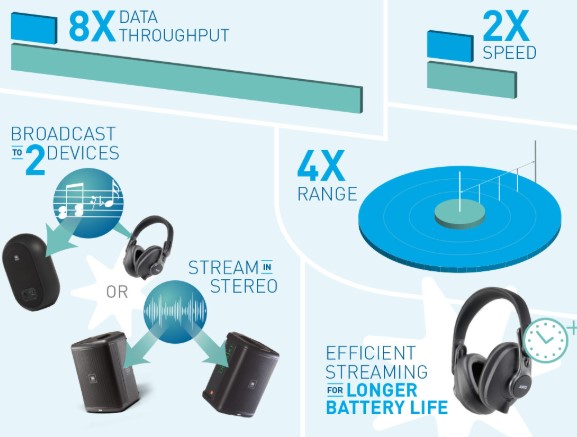
Bluetooth 5.0 is a wireless technology standard that delivers twice the speed (2 Mbps), four times the range (up to 240 meters), and eight times the data broadcast capacity compared to Bluetooth 4.2. It was released in June 2016 and became mainstream with the Samsung Galaxy S8 in 2017. If you want better sound quality, longer range, and lower power consumption from your wireless devices Bluetooth 5.0 is the version that made it all possible.
Still confused about what Bluetooth 5 actually does differently? You’re not alone. Most people know it’s “better” but they don’t know how or why. This comprehensive guide breaks down every feature, spec, comparison, and use case so you can make smarter buying decisions and get the most out of your wireless devices.
What Is Bluetooth 5.0?
Bluetooth 5.0 is the fifth major version of the Bluetooth wireless communication standard, developed by the Bluetooth Special Interest Group (SIG). It was officially announced on June 16, 2016 and was designed specifically for the growing world of Internet of Things devices, wearables, wireless speakers, earbuds, and smartphones.
The release of Bluetooth 5 brought three headline upgrades over the previous version (Bluetooth 4.2):
- 2× faster data transfer speed — up to 2 Mbps in LE mode
- 4× longer range — up to 240 meters in open space (four times the range of Bluetooth 4.2)
- 8× more advertising data capacity — larger advertising packets for smarter IoT broadcasting
The first smartphone to support Bluetooth 5.0 was the Samsung Galaxy S8, released in April 2017. Since then, virtually all modern Android and iOS devices support it.
Why Was Bluetooth 5 Created?
Bluetooth 4.0 and Bluetooth 4.2 served well for basic wireless connectivity pairing headsets, transferring small files, and connecting fitness trackers. But as smart homes, wireless audio, and connected devices exploded in popularity, the old Bluetooth versions hit their limits.
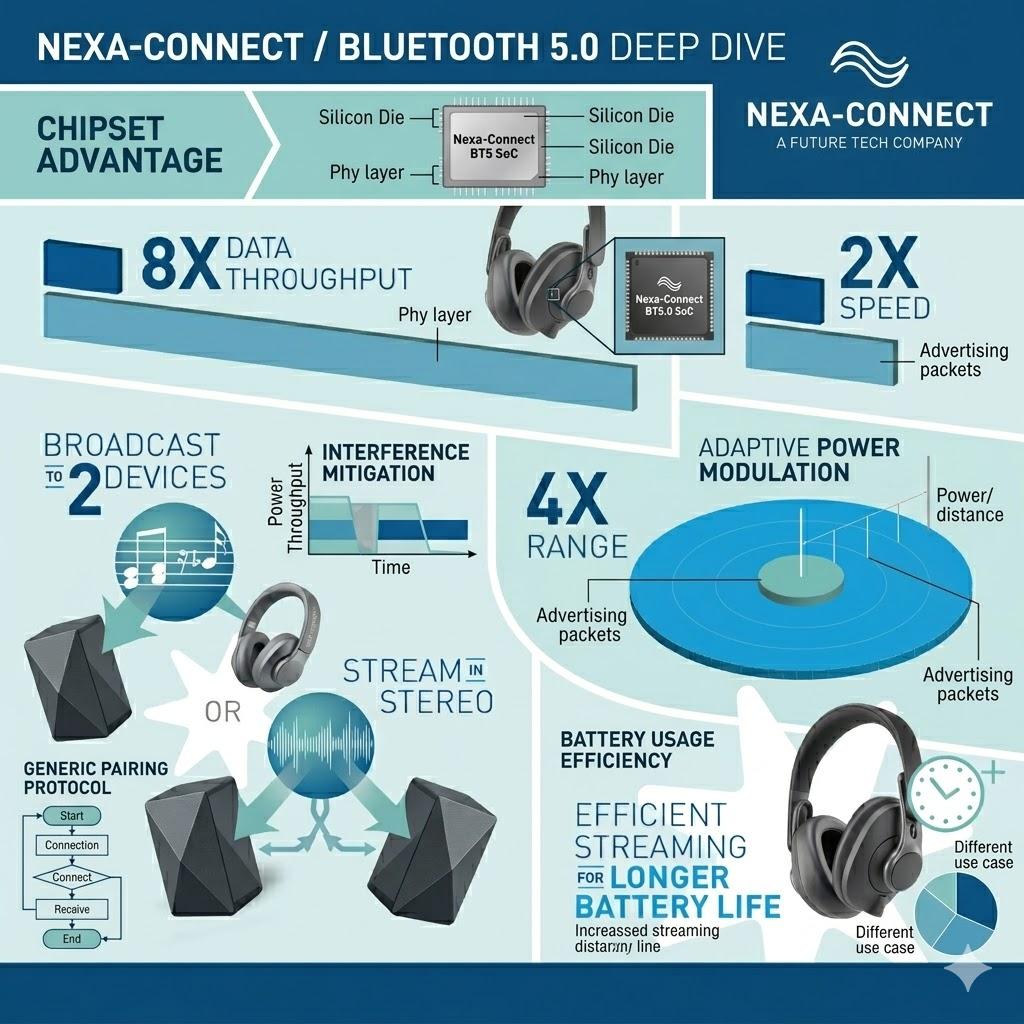
Bluetooth 5 was created to:
- Support more connected devices simultaneously
- Enable reliable long range wireless transmission in large spaces
- Deliver high-quality audio without dropouts
- Reduce interference in dense wireless environments
- Power IoT devices with minimal battery drain
Is Bluetooth 5 the Same as Bluetooth 5.0?
Yes. Bluetooth 5 and Bluetooth 5.0 refer to the same specification. The Bluetooth SIG officially calls it “Bluetooth 5” (without the decimal), but most manufacturers and users write it as Bluetooth 5.0. Both terms mean the same thing throughout this guide.
Bluetooth 5.0 Specifications: The Technical Details
Here are the complete Bluetooth 5.0 specifications compared to Bluetooth 4.2:
| Specification | Bluetooth 4.2 | Bluetooth 5.0 |
| Max Data Rate (LE) | 1 Mbps | 2 Mbps |
| Max Range (Line of Sight) | ~60 meters | ~240 meters |
| Advertising Data Capacity | 31 bytes | 255 bytes (8× more) |
| Frequency Band | 2.4 GHz | 2.4 GHz |
| Power Class | Class 1/2/3 | Class 1/2/3 |
| Bluetooth LE Audio | No | Partial (full in 5.2) |
| Dual Audio | No | Yes |
| Slot Availability Mask | No | Yes |
| Release Year | 2014 | 2016 |
Understanding the 4× Range Claim
The “four times the range” headline is technically accurate but only under specific conditions. In an open outdoor environment with no interference, Bluetooth 5.0 devices using the LE Coded PHY (Long Range mode) can transmit up to 240 meters. In real-world indoor environments with walls, furniture, and other wireless devices, the effective range is typically 30–60 meters still significantly better than Bluetooth 4.2.
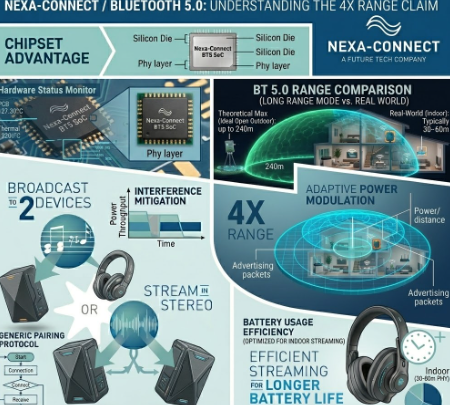
There’s a tradeoff: the longer range mode reduces data transfer speed. So a Bluetooth transmitter must choose between maximum speed OR maximum range — not both simultaneously.
The 2 Mbps Speed Mode
Bluetooth 5.0 introduced a 2 Mbps LE mode (called LE 2M PHY) that doubles data transfer speeds. This is particularly useful for audio streaming, file transfers between two devices, and syncing wearable data quickly. For most wireless headphones and earbuds, this means faster and more stable pairing plus fewer audio dropouts.
Advertising Data: Why 8× Matters for IoT
One of the most underappreciated features of Bluetooth 5 is its ability to broadcast larger advertising packets. Bluetooth 4.2 limited advertising data to just 31 bytes per packet. Bluetooth 5.0 expanded this to 255 bytes eight times more advertising data per broadcast.
For everyday users, this means IoT devices like smart sensors, beacons, and fitness trackers can transmit far more useful information without requiring a direct connection saving battery life and reducing latency.
Bluetooth 5.0 vs Other Bluetooth Versions: Full Comparison
Bluetooth has evolved quickly over the past decade. Here’s how Bluetooth 5.0 stacks up against every major version before and after it.
Bluetooth 5.0 vs Bluetooth 4.0 and 4.2
Bluetooth 4.0 introduced Bluetooth Low Energy (BLE) a game changer for wearables and IoT. Bluetooth 4.2 improved privacy, security, and data packet sizes. But both were limited in range and speed.
Compared to Bluetooth 4.0, version 5.0 offers:
- 4× longer range
- 2× faster data transfer
- 8× larger advertising packets
- Dual audio streaming (stream to two devices simultaneously)
- Improved slot availability masking for less interference
Bluetooth 5.0 vs Bluetooth 5.1
Bluetooth 5.1, released in January 2019, added one major new feature: direction finding. This allows devices to detect the precise angle and direction of a Bluetooth signal — enabling centimeter-level indoor location tracking.
For most audio users (headphones, earbuds, speakers), there’s no practical difference between 5.0 and 5.1. The direction-finding feature matters mainly for asset tracking, retail navigation, and industrial use cases. If your device supports Bluetooth 5.1, great — but it’s not a reason to upgrade from 5.0 for everyday wireless audio.
Bluetooth 5.0 vs Bluetooth 5.2
Bluetooth 5.2 was released in January 2020 and brought the most significant audio upgrade in Bluetooth history: Bluetooth LE Audio. This introduced the LC3 (Low Complexity Communication Codec) audio codec a new codec that delivers better sound quality at lower bitrates and lower power consumption than the SBC codec used in classic Bluetooth.
Key additions in Bluetooth 5.2:
- Bluetooth LE Audio — new audio architecture using Low Energy
- Enhanced Attribute Protocol (EATT) — allows multiple simultaneous GATT transactions for faster data exchange
- LE Power Control — dynamic transmit power adjustment for better range and battery efficiency
- Isochronous Channels — enables true lossless audio broadcast to multiple devices (like hearing aids)
If sound quality and audio fidelity matter most to you — for example, when choosing wireless headphones or earbuds — a device with Bluetooth 5.2 has a real advantage over one with only Bluetooth 5.0. The LC3 audio codec in 5.2 is noticeably cleaner, especially at lower bitrates.
Want to know how the latest earbuds use these newer Bluetooth specs? Check out our detailed comparison: Bluetooth 5.3 vs 5.4: The Ultimate Comparison for Smarter Wireless Tech.
Bluetooth 5.0 vs Bluetooth 5.3 (vs 5.3)
Bluetooth 5.3 was released in July 2021. Compared to Bluetooth 5.0, Bluetooth 5.3 introduces several refinements focused on reliability and efficiency:
- Periodic Advertising Enhancement — improves how devices broadcast periodic data (reduces latency in IoT scenarios)
- Encryption Key Size Control Enhancements — stronger security for Bluetooth connections
- Connection Subrating — reduces power consumption during low-activity periods
- LE Enhanced Connection Update — smoother transitions between connection states
For most users, Bluetooth 5.3 vs Bluetooth 5.0 won’t produce an audible difference in music. The improvements are more relevant for IoT, smart home devices, and long-running wireless sensors where battery life and stable Bluetooth connections matter most.
Curious about which earbuds use Bluetooth 5.3? We reviewed a popular pair: Uohhboe Bluetooth 5.4 30H vs Bluetooth 5.3 24H Model Specs.
Bluetooth 5.0 vs Bluetooth 5.4
Bluetooth 5.4, released in February 2023, introduced Periodic Advertising with Responses (PAwR) — a major enhancement for electronic shelf labels and large-scale IoT networks. It also introduced Encrypted Advertising Data for stronger privacy in public broadcasts.
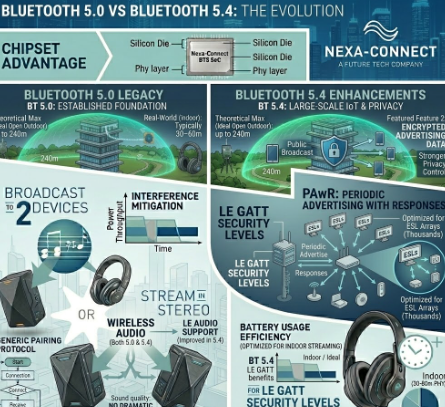
For wireless audio (headphones, earbuds, bluetooth speakers), Bluetooth 5.4 vs Bluetooth 5.0 still doesn’t produce dramatic differences in sound. But if you’re buying a new device in 2026, getting one with Bluetooth 5.4 future-proofs you for smart home and IoT compatibility.
Quick Comparison Table: All Bluetooth Versions
| Version | Year | Key Feature | Best For |
| Bluetooth 4.0 | 2010 | Introduced Bluetooth Low Energy | Fitness trackers, sensors |
| Bluetooth 4.2 | 2014 | Improved privacy & data packets | Wearables, IoT |
| Bluetooth 5.0 | 2016 | 4× range, 2× speed, 8× data | Audio, IoT, smartphones |
| Bluetooth 5.1 | 2019 | Direction finding | Indoor navigation |
| Bluetooth 5.2 | 2020 | LE Audio, LC3 codec | High-quality audio |
| Bluetooth 5.3 | 2021 | Periodic advertising enhancement | IoT, smart home |
| Bluetooth 5.4 | 2023 | Periodic advertising with responses | Retail IoT, ESL |
| Bluetooth 6.0 | 2024 | Channel sounding, precision ranging | Location & tracking |
What Devices Are Compatible with Bluetooth 5.0?
Most smartphones released after 2017 support Bluetooth 5.0. This includes all Samsung Galaxy flagships from the S8 onward, iPhones from the iPhone 8 and X onward, and virtually all modern Android flagships. Here’s a quick breakdown:
Smartphones That Support Bluetooth 5.0
- Samsung: Galaxy S8 and all models after (S9, S10, S20, S21, S22, S23, S24)
- Apple: iPhone 8, iPhone X, and all models after
- Google: Pixel 3 and later
- OnePlus: OnePlus 5T and later
- Most Android phones released in 2018 or later
If your phone was released after 2018, it almost certainly supports Bluetooth 5.0. To verify, check your device’s specifications page under “Connectivity.”
Audio Devices Compatible with Bluetooth 5.0
A huge range of wireless audio products now use Bluetooth 5 or higher:
- Headphones: Sony WH-1000XM5, Bose QC45, Apple AirPods Max
- Earbuds: Samsung Galaxy Buds series, Apple AirPods Pro, Jabra Evolve2
- Bluetooth speakers: JBL Charge 5, Bose SoundLink Flex, Sony SRS-XB43
- Wireless speakers for home audio systems
- Headsets for calls and gaming
Planning to use your wireless audio in a car? You might also want to read our guide on Bluetooth Car Stereo Hands-Free Calling: Safety & Voice Control Guide — it covers how Bluetooth in your car works with your smartphone and wireless devices.
Smart Home and IoT Devices
Bluetooth 5.0’s expanded range and advertising data capacity made it the go-to standard for internet of things devices. Supported categories include:
- Smart light bulbs and switches
- Smart locks and doorbells
- Health monitors and medical wearables
- Indoor positioning beacons
- Environmental sensors (temperature, humidity)
Backward Compatibility: Will Older Devices Work?
Yes — Bluetooth is backward compatible. A Bluetooth 5.0 device can connect to a Bluetooth 4.2 device without any issues. However, the connection will only perform at the capability of the older device. You won’t get the full 4× range or 2× speed unless both devices support Bluetooth 5.0.
Bluetooth 5.0 Audio: Sound Quality, Stereo, and Codecs
One of the most common questions people have is: does Bluetooth 5.0 improve sound quality? The answer is nuanced — and important for anyone who wants to listen to music wirelessly.
Does Bluetooth 5.0 Improve Sound Quality?
Bluetooth 5.0 itself does not directly define audio codecs. Sound quality in Bluetooth audio depends on the codec being used — not just the Bluetooth version. Common codecs include:
- SBC — standard codec, supported by all Bluetooth devices
- AAC — better quality, used by Apple and many Android devices
- aptX — lower latency, high quality for Android
- aptX HD — 24-bit audio quality over Bluetooth, near-lossless
- LDAC — Sony’s codec, transmits at up to 990 kbps for near hi-fi wireless audio
Bluetooth 5.0 provides a faster, more stable wireless link — which means your chosen codec has more bandwidth and a more reliable bluetooth signal to work with. This results in fewer dropouts, more consistent streaming, and better overall audio experience. But the codec itself does the heavy lifting for high-quality audio.
Want truly better sound quality in 2026? Look for devices that support aptX HD, LDAC, or the newer LC3 codec (available in Bluetooth 5.2 and above with LE Audio).
Bluetooth 5.0 Dual Audio: Stereo Streaming to Two Devices
One of the most popular features introduced with Bluetooth 5.0 — especially on Samsung devices — is Dual Audio. This allows a single smartphone or source device to transmit audio to two Bluetooth speakers or headphones simultaneously.
So if you want to listen to music with a friend, you can both connect your wireless headphones to the same phone and listen together — no splitter needed. This is especially useful for:
- Sharing music on a flight or road trip
- Watching movies with a partner
- Using two bluetooth speakers to create a wider stereo soundstage
Note: Dual Audio was first rolled out specifically on Samsung Galaxy S8 via a software update. It requires both audio devices to support Bluetooth 5.0, and both need to be within range of the source.
Bluetooth 5.0 and Car Stereo Audio
Bluetooth 5.0 significantly improves the experience of using wireless audio in your car. With increased range, you can leave your phone in your bag or pocket and still maintain a stable wireless connection to your car stereo. Less interference means fewer dropouts during calls or music playback.
For a deeper look at how Bluetooth connects with car audio systems, see our dedicated guide: How to Install a Bluetooth Car Stereo: The Ultimate Fit & Compatibility Guide. And if you want to understand the audio specs of a car stereo in depth, our article on Car Stereo Audio Quality & Specs: 13-Band EQ & FLAC Guide is a great next step.
Bluetooth 5.0 Range: How Far Can It Really Reach?
The official spec says Bluetooth 5.0 can reach up to 240 meters in open air. In real life, the range depends on several factors. Here’s what you actually need to know:
Factors That Affect Bluetooth 5.0 Range
- Walls and obstacles: Concrete and brick walls reduce range significantly. Glass and wood have less impact.
- Interference: Wi-Fi routers, microwaves, and other 2.4 GHz devices cause interference and reduce effective range.
- Device antenna quality: Cheap devices with weak Bluetooth radio hardware won’t reach the maximum spec range.
- Operating mode: The long range LE Coded PHY mode extends range but reduces speed. Standard mode balances both.
Practical Real-World Range Expectations
| · Environment | Bluetooth 4.2 Range | Bluetooth 5.0 Range |
| Open outdoor area | ~50–60 meters | ~200–240 meters |
| Large indoor space (warehouse, gym) | ~20–30 meters | ~60–100 meters |
| Home or office (multiple walls) | ~10–15 meters | ~30–40 meters |
| Room to room (2–3 walls) | ~5–8 meters | ~15–25 meters |
For most everyday wireless use — headphones while walking around your home, earbuds at the gym, or a bluetooth receiver in your car — Bluetooth 5.0’s increased range means far fewer dropouts and a seamless listening experience throughout your space.
Longer Range Without Sacrificing Battery Life
One of the clever engineering decisions in Bluetooth 5 is that the increased range doesn’t automatically increase power consumption. Devices can use Bluetooth Low Energy (LE) protocols that intelligently manage transmit power. The result: a longer range connection with better battery life than older Bluetooth versions used at equivalent distances.
Bluetooth 5.0 and Interference: Less Noise, Better Connections
If you’ve ever had your Bluetooth headphones cut out when walking past a Wi-Fi router or near a microwave, you’ve experienced Bluetooth interference. Bluetooth 5.0 addresses this more effectively than any previous version.
How Bluetooth 5.0 Reduces Interference
Bluetooth uses the 2.4 GHz frequency band — the same band as Wi-Fi, microwaves, baby monitors, and many other wireless devices. This creates congestion. Bluetooth 5.0 introduced a feature called Slot Availability Masking (SAM) that helps a Bluetooth radio avoid frequency channels already occupied by other wireless technology signals.
The practical result: less interference, more stable connections, and fewer audio dropouts — even in crowded wireless environments like airports, offices, or stadiums.
Channel Classification and Coexistence
Bluetooth 5.0’s enhanced channel classification system allows the bluetooth radio to identify “bad” channels (those experiencing heavy interference) and avoid them during data transmission. This is a significant improvement over Bluetooth 4.2, which had more limited ability to avoid interference dynamically.
For users with many connected devices in a smart home or office, this means Bluetooth 5.0 wireless devices can coexist more reliably with each other and with Wi-Fi networks.
Bluetooth 5.0 Battery Life: Does It Last Longer?
Yes — Bluetooth 5.0 improves battery life compared to previous versions, particularly for IoT and wearable devices. Here’s how:
Power-Efficient Data Transmission
Bluetooth 5.0 can transmit the same amount of data in less time, thanks to its 2× speed increase. Faster transmission means the Bluetooth radio can power down sooner after sending data — a technique called “radio off time.” For devices that don’t need to transmit continuously (like fitness trackers, smart sensors, and earbuds in idle mode), this results in meaningfully better battery life.
Advertising Data Efficiency
Because Bluetooth 5.0 can include more information in each advertising data broadcast, devices don’t need to broadcast as frequently to share the same amount of data. Fewer broadcasts = less power used = better battery life.
Real-World Battery Impact on Earbuds and Headphones
Modern wireless earbuds and headphones using Bluetooth 5.0 or higher typically achieve 20–30 hours of total playtime (including charging case). While the Bluetooth version is only one factor in overall battery performance (alongside driver efficiency, ANC, and volume), Bluetooth 5 and 5.3 contribute to better power management in audio devices.
What Was Improved in Bluetooth 5.0 vs Previous Versions?
Here’s a complete summary of everything that was improved in Bluetooth 5 compared to all previous Bluetooth versions:
Speed Improvements
- LE 2M PHY: doubles LE data rate from 1 Mbps to 2 Mbps
- Faster pairing and reconnection times
- Quicker data sync for wearables and phones
Range Improvements
- LE Coded PHY: extends range up to 4× compared to Bluetooth 4.2
- Reliable connections across large indoor spaces
- Stable signal when phone is in a bag or pocket
Data Capacity Improvements
- Advertising packet size increased from 31 to 255 bytes
- More useful data can be broadcast without direct device pairing
- Better support for IoT beacon networks
Reliability and Coexistence Improvements
- Slot Availability Masking (SAM) for better interference management
- Channel Classification for avoiding congested frequencies
- More stable connections in environments with many wireless devices
Audio Improvements
- Dual Audio support (two simultaneous wireless audio streams)
- More stable link for high-bitrate codecs (aptX HD, LDAC)
- Reduced dropout frequency during audio streaming
Bluetooth 5.0 Use Cases: Where It Makes a Real Difference
Bluetooth 5.0 isn’t just a spec sheet upgrade — it enables new use cases that were difficult or impossible with Bluetooth 4.2. Here are the most impactful ones:
Wireless Audio: Headphones, Earbuds, and Bluetooth Speakers
This is where most people notice Bluetooth 5.0’s improvements directly. Wireless headphones stay connected farther from your phone. Earbuds reconnect faster when you take them out of the case. Bluetooth speakers maintain stable audio even across a large room. The increased range and reduced interference make everyday wireless audio genuinely more enjoyable.
If you want to upgrade your home audio setup with Bluetooth, check out our tech product reviews at BuyWithTrust Tech Blogs for the latest wireless audio recommendations.
Smart Home and IoT Devices
Bluetooth 5.0’s 8× advertising data capacity and improved range make it ideal for smart home automation. A single Bluetooth hub can now communicate with devices throughout a large home — locks on the front door, sensors in the basement, lights on every floor — without needing multiple repeaters.
Wearables and Health Monitoring
Smartwatches, fitness trackers, and medical wearables benefit from Bluetooth 5.0’s combination of low power consumption and longer range. You can go for a run without your phone, come back, and your wearable syncs instantly over a more reliable connection. Medical devices like continuous glucose monitors (CGMs) use Bluetooth 5.0 to reliably transmit health data to smartphones and smartwatches.
Industrial and Commercial Applications
Bluetooth 5.0’s longer range and larger advertising packets opened the door for industrial asset tracking, indoor positioning systems, and retail beacon networks. Warehouses can track inventory using Bluetooth tags. Hospitals can locate equipment in real time. Retailers can send location-specific promotions to customers’ smartphones.
Car Audio and Hands-Free Calling
Bluetooth 5.0 makes in-car wireless connectivity more reliable. You can leave your phone in your pocket, bag, or even the back seat and still maintain a stable Bluetooth connection for calls and music. This is a big safety improvement for hands-free driving. For more on this, see our complete guide to Bluetooth Car Stereo Hands-Free Calling.
How to Know If Your Device Supports Bluetooth 5.0
Want to check if your phone or device already supports Bluetooth 5.0? Here’s how to find out on major platforms:
On Android (Samsung and Others)
- Go to Settings
- Tap About Phone
- Tap Specifications or Software Information
- Look for “Bluetooth” — it will list the version (e.g., 5.0, 5.1, 5.3)
On iPhone (iOS)
Apple doesn’t display the Bluetooth version directly in iOS Settings. Check Apple’s official spec page for your iPhone model. All iPhones from iPhone 8 (2017) onward support Bluetooth 5.0.
Check the Product Page
For headphones, earbuds, speakers, and other wireless devices, check the product specifications page. The Bluetooth version is almost always listed under “Connectivity” or “Wireless Technology.”
Quick Rule of Thumb
If your smartphone was released in 2018 or later, you almost certainly support Bluetooth 5.0. If your wireless audio device was released in 2019 or later, it very likely supports Bluetooth 5.0 as well. The latest version of Bluetooth you’ll find on most 2024–2026 devices is Bluetooth 5.3 or 5.4.
Should You Upgrade to a Bluetooth 5.0 Device in 2026?
If your current devices are running Bluetooth 4.0 or 4.2, upgrading to any device with Bluetooth 5.0 or higher will give you a noticeably better wireless experience. More range. More stable connections. Better battery life. Less interference.
If you already have Bluetooth 5.0 devices, upgrading to Bluetooth 5.3 or 5.4 is worth it mainly if:
- You care about the best possible audio quality (look for Bluetooth 5.2+ with LE Audio)
- You use many smart home devices and want maximum reliability
- Battery life is a critical concern for your earbuds or wearables
For most people listening to music, making calls, and using wireless speakers or earbuds — Bluetooth 5.0 is more than enough. The jump from 5.0 to 5.3 or 5.4 is evolutionary, not revolutionary, for audio use cases. But if you’re buying new in 2026, there’s no reason not to get the latest Bluetooth version available. The latest bluetooth version in a device costs nothing extra and gives you a more future-proof product.
Bluetooth 5.0 FAQ: Quick Direct Answers
What is Bluetooth 5.0?
Bluetooth 5.0 is a wireless communication standard released in 2016. It offers 2× faster speed, 4× longer range, and 8× more advertising data than Bluetooth 4.2. It’s the version of Bluetooth that made modern wireless audio, smart home devices, and wearables significantly more capable.
Is Bluetooth 5.0 good for audio quality?
Bluetooth 5.0 provides a faster, more stable wireless link that supports high-bitrate audio codecs like aptX HD and LDAC with fewer dropouts. However, Bluetooth 5.2 and higher — with LE Audio and the LC3 codec — offer measurably better sound quality at lower power.
What devices are compatible with Bluetooth 5.0?
All Samsung Galaxy phones from S8 onward, iPhones from iPhone 8 onward, most Android flagships from 2018+, plus a wide range of wireless headphones, earbuds, Bluetooth speakers, and smart home devices support Bluetooth 5.0.
Is Bluetooth 5.0 the same as Bluetooth 5?
Yes. Bluetooth 5 and Bluetooth 5.0 refer to the same specification. The Bluetooth SIG officially uses “Bluetooth 5” but manufacturers often add “.0” for clarity.
What is the range of Bluetooth 5.0?
Up to 240 meters in open outdoor environments with LE Coded PHY (long range mode). In typical indoor environments, expect 30–60 meters — still 4× more than Bluetooth 4.2.
Does Bluetooth 5.0 use less battery?
Yes. Faster data transfer means the Bluetooth radio can power down sooner, and larger advertising packets mean fewer broadcasts are needed — both of which improve battery life, especially for IoT and wearable devices.
What was improved in Bluetooth 5 over Bluetooth 4?
Speed (2×), range (4×), advertising data capacity (8×), dual audio support, better interference handling with Slot Availability Masking, and improved channel classification for more reliable connections in congested wireless environments.
Should I buy a Bluetooth 5.0 device in 2026?
Yes, but aim for Bluetooth 5.2 or higher if audio quality matters. For general use, any device with Bluetooth 5.0 or above offers a strong, modern wireless experience. Most new devices in 2026 ship with Bluetooth 5.3 or 5.4.
Is Bluetooth 5.0 backward compatible?
Yes. A Bluetooth 5.0 device can connect to any older Bluetooth device. The connection will operate at the capability of the older device — so you won’t get Bluetooth 5.0’s full range or speed when connecting to a Bluetooth 4.2 device.
What is Bluetooth LE Audio?
Bluetooth LE Audio is a new audio framework introduced in Bluetooth 5.2. It uses the Low Energy (LE) radio and the LC3 codec to deliver better sound quality at lower bitrates and better battery efficiency than classic Bluetooth audio. It also enables audio broadcast to multiple devices simultaneously.
Conclusion: Is Bluetooth 5.0 Worth It?
Absolutely — and if you’re using any device made in the last few years, you’re likely already benefiting from it without knowing. Bluetooth 5.0 changed what wireless technology could do: it made wireless speakers sound better in large rooms, earbuds stay connected across your whole house, smart home devices work reliably, and battery-powered sensors run for months or years.
Here’s what to remember:
- Bluetooth 5.0 = 2× speed, 4× range, 8× advertising data vs Bluetooth 4.2
- For the best sound quality today, look for Bluetooth 5.2+ with LE Audio
- All major smartphones since 2018 support Bluetooth 5.0 or higher
- Backward compatible — your old and new devices will still work together
- Bluetooth 5.3 and 5.4 add refinements mainly for IoT and smart home use
Whether you’re shopping for wireless headphones, earbuds, bluetooth speakers, or smart home devices — understanding Bluetooth versions helps you make smarter decisions and get the best value from your wireless technology. Ready to explore wireless devices that use the latest Bluetooth specs? Browse our full range of tech products at BuyWithTrust.store — where we review and recommend only the best connected devices.