
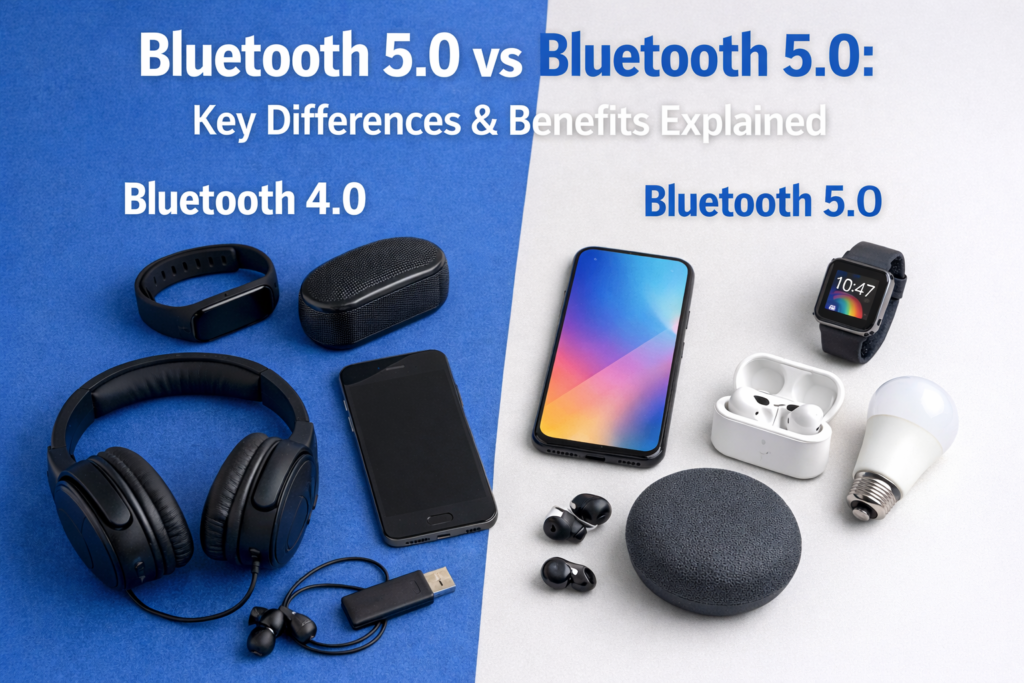
Bluetooth 5.0 vs Bluetooth 4.0: Key Differences & Benefits Explained
Bluetooth technology has evolved significantly over the years, and its versions continue to enhance the way devices communicate wirelessly. Bluetooth 5.0 vs Bluetooth 4.0 is a frequent discussion among tech enthusiasts and device users. If you’re wondering what’s the difference between Bluetooth 5.0 and Bluetooth 4.0, you’re in the right place. Bluetooth 5.0 brings improvements that make it faster, more reliable, and ideal for modern wireless needs.
While Bluetooth 4.0 laid the foundation for wireless communication, Bluetooth 5.0 enhances the range and data transfer speeds, offering a superior experience for everything from audio streaming to Internet of Things (IoT) devices. This guide will dive into the key differences between Bluetooth 5.0 and Bluetooth 4.0, and show how Bluetooth 5.0 beats its predecessor in several key areas.Key Differences Between Bluetooth 5.0 vs Bluetooth 4.0
1. Speed and Data Transfer
When comparing Bluetooth 5.0 vs Bluetooth 4.0, the speed difference is significant. Bluetooth 5.0 offers twice the speed of Bluetooth 4.0, with a maximum data transfer rate of 2 Mbps. On the other hand, Bluetooth 4.0 maxes out at 1 Mbps. This increased speed allows for faster data transfer, making Bluetooth 5.0 ideal for tasks like audio streaming and file sharing.
Bluetooth 5.0 also supports four different data rates, including a low-speed 125 kbps mode, and a high-speed mode of 2 Mbps. The greater bandwidth of Bluetooth 5.0 makes it highly effective for modern wireless technologies such as wireless speakers, beacons, and smartphones.
2. Range and Connectivity
One of the standout features of Bluetooth 5.0 vs Bluetooth 4.0 is range. Bluetooth 5.0 offers up to four times the range of Bluetooth 4.0, with a maximum range of 240 meters (800 feet) compared to 60 meters (200 feet) for Bluetooth 4.0. This increased range is crucial for applications such as IoT connectivity, where devices need to communicate over larger distances.
Bluetooth 5.0 also provides improved signal reliability ensuring that devices maintain strong connections even when there are obstacles in the environment. This makes it perfect for devices like fitness trackers or Bluetooth beacons that require constant communication over longer distances.
3. Power Efficiency
Another important factor when comparing Bluetooth 5.0 vs Bluetooth 4.0 is power consumption. While Bluetooth 4.0 introduced Bluetooth Low Energy (BLE) to extend battery life in low-power devices, Bluetooth 5.0 further improves upon this, offering better battery efficiency without sacrificing performance. This makes Bluetooth 5.0 ideal for small devices that need to operate for extended periods without draining their batteries.
Bluetooth 5.0 ensures devices with BLE operate more effectively, while also allowing data transfer without significant power consumption, making it a game-changer for devices like wireless headphones or IoT devices.
4. Improved Audio and Media Streaming
When it comes to audio streaming, Bluetooth 5.0 delivers better audio quality than Bluetooth 4.0, thanks to its increased data transfer speed and improved bandwidth. Bluetooth 5.0 enables higher-quality wireless audio without interruptions, whether you’re streaming music on Bluetooth headphones or connecting to a Bluetooth speaker.
With Bluetooth 5.0, dual audio capabilities are possible, meaning you can connect two Bluetooth speakers or headphones to one device simultaneously, providing a seamless audio experience. This capability is not available with Bluetooth 4.0.
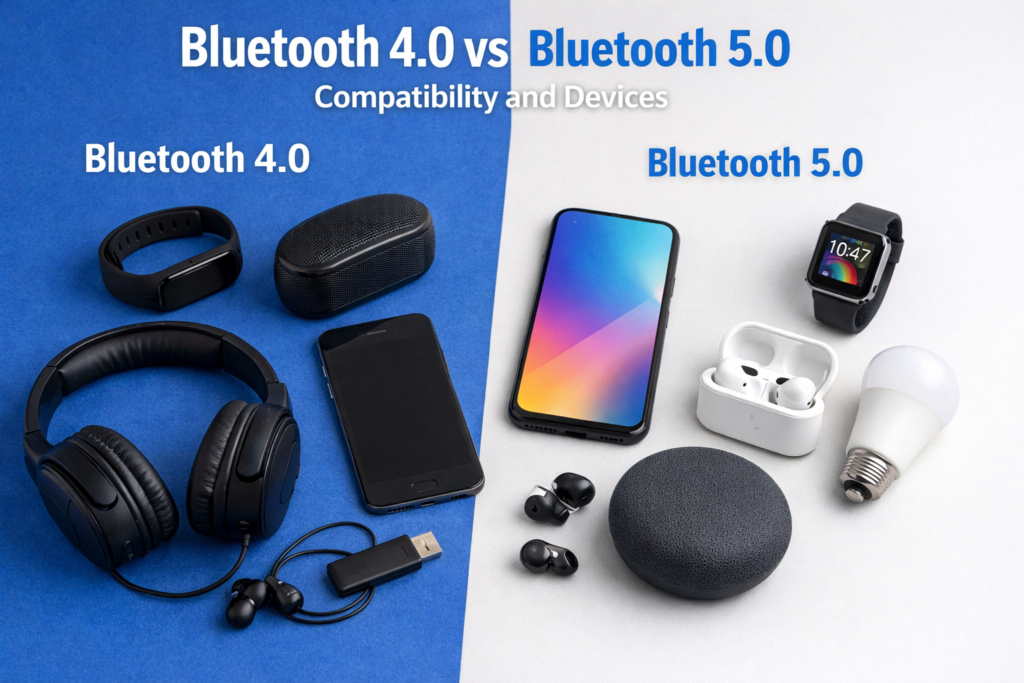
Bluetooth 4.0 vs Bluetooth 5.0: Compatibility and Devices
1. Backward Compatibility
Both Bluetooth 4.0 and Bluetooth 5.0 are backward compatible, meaning Bluetooth 5.0 can connect with Bluetooth 4.0 devices. However, you won’t get the full range, speed, or low power efficiency unless both devices support Bluetooth 5.0. Devices with Bluetooth 5.0 will also work with older versions like Bluetooth 4.2 or Bluetooth 4.0, but some features may not be available depending on the older version.
2. IoT Connectivity
The evolution of Bluetooth technology has made it a cornerstone of the Internet of Things (IoT). Bluetooth 5.0 offers improved IoT connectivity compared to Bluetooth 4.0, with higher message capacity and better range. This makes Bluetooth 5.0 a preferred choice for IoT devices like smart home hubs, fitness trackers, and connected appliances.
Bluetooth 5.0 vs Bluetooth 4.0: Key Comparison Table
| Feature | Bluetooth 5.0 | Bluetooth 4.0 |
|---|---|---|
| Maximum Speed | 2 Mbps | 1 Mbps |
| Range | Up to 240 meters (800 feet) | Up to 60 meters (200 feet) |
| Power Efficiency | Improved Low Energy (BLE) | Low Energy (BLE) |
| Data Transfer | Four different data rates (125 kbps, 500 kbps, 1 Mbps, 2 Mbps) | 1 Mbps |
| Audio Streaming | Supports dual audio, higher quality audio | Basic audio streaming |
| IoT Connectivity | Improved IoT capabilities and support | Limited IoT support |
| Backward Compatibility | Fully compatible with older versions | Compatible with older devices |
| Devices Supported | Modern devices like smartphones, wearables, smart home devices | Older devices like fitness trackers, speakers |
| Message Capacity | Higher message capacity for IoT devices | Lower message capacity for IoT devices |
Bluetooth 5.0 vs Bluetooth 4.0: Which is Better for Your Devices?
If you’re considering an upgrade or wondering whether your device should support Bluetooth 5.0, here’s a quick comparison:
- Bluetooth 5.0: Offers faster speeds, longer range, better power efficiency, and improved data transfer capabilities. Ideal for modern wireless devices and IoT connectivity.
- Bluetooth 4.0: Still highly effective for low-power devices, wireless audio streaming, and fitness trackers. Suitable for older devices and simpler wireless needs.
Bluetooth 5.3 vs Bluetooth 5.4: The Latest Advancements in Bluetooth Technology
If you’re intrigued by the advancements of Bluetooth 5.0, you might also want to explore the differences between Bluetooth 5.3 vs Bluetooth 5.4. These newer versions continue to push the boundaries of Bluetooth technology, offering even greater energy efficiency, security, and device support. For a detailed comparison, be sure to check out our article on Bluetooth 5.3 vs Bluetooth 5.4 for more insights.
How to Connect Bluetooth Headphones to PS5
If you’re looking to connect your Bluetooth headphones to your PS5, here’s a quick guide:
- Turn on your Bluetooth headphones and set them to pairing mode.
- On the PS5, go to Settings > Sound > Audio Output.
- Select Output Device and choose your Bluetooth headphones from the list.
For a step-by-step tutorial and troubleshooting tips, refer to our full guide on How to Connect Bluetooth Headphones to PS5.
Conclusion
In conclusion, the decision between Bluetooth 5.0 vs Bluetooth 4.0 comes down to the needs of your devices. Bluetooth 5.0 offers a significant leap forward in terms of speed, range, and energy efficiency, making it the ideal choice for modern wireless applications. Whether you’re using wireless headphones, smartphones, or IoT devices, Bluetooth 5.0 provides a better more reliable experience .
If you’re upgrading your device or building a smart home setup, Bluetooth 5.0 is undoubtedly the future of wireless connectivity. For further questions about Bluetooth technology or to find the best Bluetooth devices, contact us today!