
Frequency for Bluetooth: Surprising Range & Signal Secrets
The frequency for Bluetooth operates between 2.402 GHz and 2.480 GHz within the 2.4 GHz ISM radio band. Bluetooth devices use radio waves and frequency hopping technology to transmit data between devices while minimizing interference from Wi-Fi and other wireless signals.
Many people struggle to understand questions like:
- What frequency does Bluetooth use?
- Is Bluetooth using radio waves?
- What is the Bluetooth frequency range?
- Why do signals sometimes interfere with Wi-Fi?
These problems can cause frustration, especially when wireless headphones, keyboards, or smart devices stop working properly.
The good news is that understanding the frequency for Bluetooth communication can help you troubleshoot connection issues, improve device compatibility, and choose the right Bluetooth version for better performance.
In this guide, you’ll learn:
- How Bluetooth technology works
- The Bluetooth frequency band and spectrum
- The exact Bluetooth frequency range used for communication
- Whether Bluetooth uses radio waves
- How Bluetooth power output affects range
- And how newer versions improve wireless performance
You will also see how Bluetooth frequency interacts with modern versions like Bluetooth 5.0 vs Bluetooth 4.0 and the latest upgrades such as Bluetooth 5.3 vs 5.4 which significantly enhance connectivity and efficiency.
What Is Bluetooth Technology?
Define Bluetooth Technology
To define Bluetooth technology, it is a short-range wireless communication system that allows electronic devices to exchange data using radio signals. The technology was designed to replace wired connections such as serial cables, audio connectors, and USB links.
Bluetooth technology enables devices to create a wireless personal area network (WPAN) where multiple devices can communicate securely within a limited range.
Today, Bluetooth is integrated into billions of devices worldwide. Some common examples include:
- Smartphones
- Wireless headphones and earbuds
- Smart watches and fitness trackers
- Smart home devices
- Wireless keyboards and mice
- Car infotainment systems
- Gaming accessories
Because Bluetooth is designed for low power consumption, it is ideal for battery-powered devices that need constant connectivity without draining power quickly.
Another key advantage of Bluetooth technology is its automatic pairing capability. Devices can discover and connect to each other automatically once pairing is completed.
Define Bluetooth
When we define Bluetooth, it refers to a wireless communication protocol that allows devices to send and receive data using short-range radio waves.
Bluetooth connections operate through tiny microchips embedded inside electronic devices. These chips include:
- A radio transmitter
- A receiver
- Signal processing hardware
Together, these components allow devices to transmit signals across the Bluetooth radio frequency spectrum.
Bluetooth connections are commonly used for transmitting:
- Audio streams
- Data files
- Device control signals
- Sensor information
Frequency for Bluetooth Communication
The frequency for Bluetooth communication is one of the most important aspects of Bluetooth technology.
Bluetooth operates within the 2.4 GHz Industrial, Scientific, and Medical (ISM) radio band, which is a globally available wireless spectrum used by many technologies.
This band allows devices to communicate wirelessly without requiring a license from regulatory authorities.
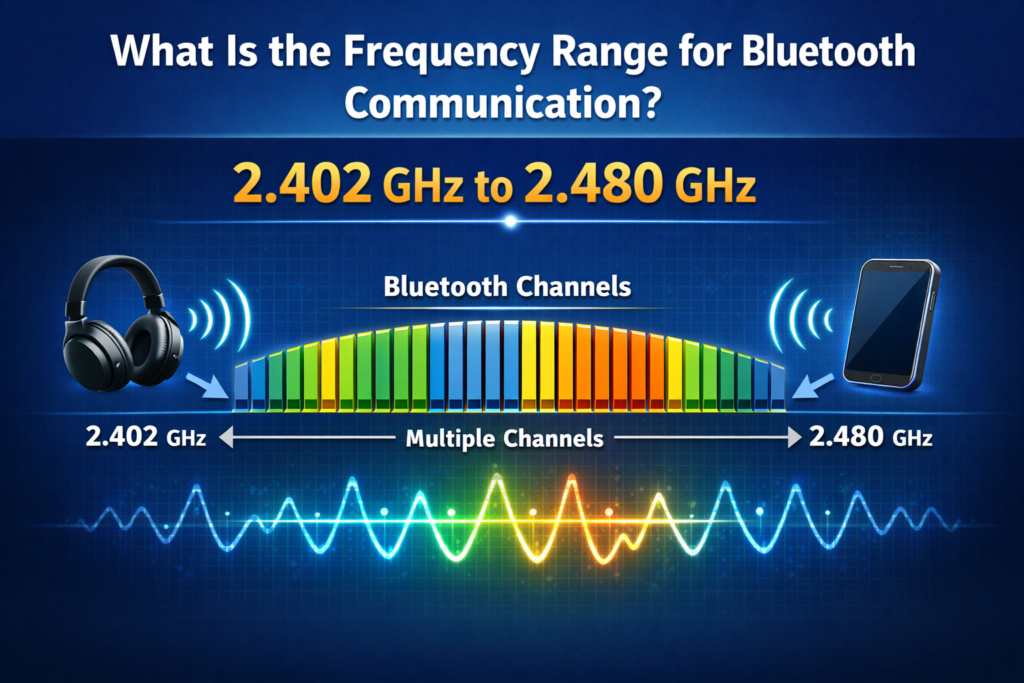
What Is the Frequency Range for Bluetooth Communication?
The official Bluetooth frequency range is:
- 2.402 GHz to 2.480 GHz
Within this spectrum, Bluetooth divides the band into multiple channels that devices use to transmit data efficiently.
Key characteristics of the Bluetooth frequency range include:
- Worldwide compatibility
- Efficient wireless communication
- Support for multiple devices
- Reduced signal interference
Bluetooth signals travel through radio waves, which means they can pass through air, walls, and obstacles within a certain range.
Because Bluetooth operates in a shared wireless spectrum, it must manage interference carefully to maintain stable connections.
Bluetooth Frequency Band Explained
The Bluetooth frequency band is part of the 2.4 GHz radio spectrum, which is one of the most widely used wireless frequency ranges in the world.
Many wireless technologies operate within this band, including:
- Wi-Fi networks
- Wireless routers
- Smart home systems
- Wireless keyboards and mice
- Microwave ovens
Since multiple technologies share this spectrum, Bluetooth uses a special technique called frequency hopping spread spectrum (FHSS) to maintain reliable connections.
How Frequency Hopping Works
Frequency hopping allows Bluetooth devices to rapidly switch between multiple channels during communication.
Instead of transmitting data on a single channel, Bluetooth jumps across different channels many times per second.
This approach offers several advantages:
- Reduces interference from Wi-Fi networks
- Prevents signal collisions between devices
- Maintains stable wireless communication
- Improves reliability in crowded environments
For example, if one channel becomes crowded with wireless signals, Bluetooth automatically switches to another channel in the Bluetooth spectrum.
What Waves Does Bluetooth Use?
- Many people wonder what waves Bluetooth uses to transmit data.
- Bluetooth uses radio waves, which are a form of electromagnetic radiation used for wireless communication.
- Radio waves are ideal for short-distance communication because they:
Support fast data transmission
- Travel efficiently through air
- Penetrate walls and obstacles
- Require minimal power
Is Bluetooth Radio Waves?
Yes, Bluetooth communication relies entirely on radio waves.
The Bluetooth radio frequency system uses low-power radio signals to transmit information between devices.
When two devices connect through Bluetooth:
- One device sends a radio signal.
- The receiving device detects the signal.
- Both devices exchange data through synchronized radio channels.
These radio signals operate within the Bluetooth spectrum, which ensures efficient communication without requiring high power consumption.
Bluetooth Spectrum and Wireless Communication
The Bluetooth spectrum refers to the portion of the radio frequency spectrum allocated for Bluetooth communication. Bluetooth operates within the 2.4 GHz ISM band, which provides enough bandwidth to support millions of wireless devices globally. Within this spectrum, Bluetooth devices divide the band into smaller channels.
Each channel carries a portion of the transmitted data, which improves communication efficiency.
Advantages of the Bluetooth spectrum include:
- Global compatibility
- Efficient bandwidth usage
- Reduced interference
- Support for multiple connected devices
Bluetooth Power Output and Device Range
Another important factor affecting Bluetooth communication is Bluetooth power output. The power output determines how far a Bluetooth signal can travel between devices. bluetooth devices are categorized into three main classes based on their transmission power.
Bluetooth Device Classes
| Bluetooth Class | Power Output | Typical Range |
| Class 1 | 100 mW | Up to 100 meters |
| Class 2 | 2.5 mW | Around 10 meters |
| Class 3 | 1 mW | Around 1 meter |
Most consumer electronics, including smartphones and wireless earbuds, use Class 2 Bluetooth, which offers a good balance between range and battery efficiency.
How Modern Bluetooth Versions Improve Frequency Efficiency
Although the frequency for Bluetooth remains within the same 2.4 GHz band, newer Bluetooth versions significantly improve wireless performance.
These improvements include:
- Faster data transfer speeds
- Lower power consumption
- Greater wireless range
- Improved interference management
For example, newer standards such as Bluetooth 5.0 vs Bluetooth 4.0 demonstrate major improvements in speed and range.
Similarly, modern upgrades like Bluetooth 5.3 vs 5.4 introduce advanced power management and improved connection stability.
If you want to understand these improvements in detail, you can explore our guides on:
- Bluetooth 5.0 vs Bluetooth 4.0
- Bluetooth 5.3 vs 5.4
- Bluetooth 5.0 vs Bluetooth 4.0: Key Differences & Benefits Explained
Real-World Example of Bluetooth Frequency in Action.
Consider a common situation where someone connects wireless headphones to a smartphone.
Here is how the Bluetooth communication process works:
- The smartphone searches for nearby Bluetooth devices.
- The headphones broadcast their signal within the Bluetooth frequency band.
- The phone detects the signal and pairs with the device.
- Audio signals are transmitted using radio waves through the Bluetooth frequency range.
Because Bluetooth uses frequency hopping, the signal remains stable even if nearby devices are using Wi-Fi or other wireless technologies.