
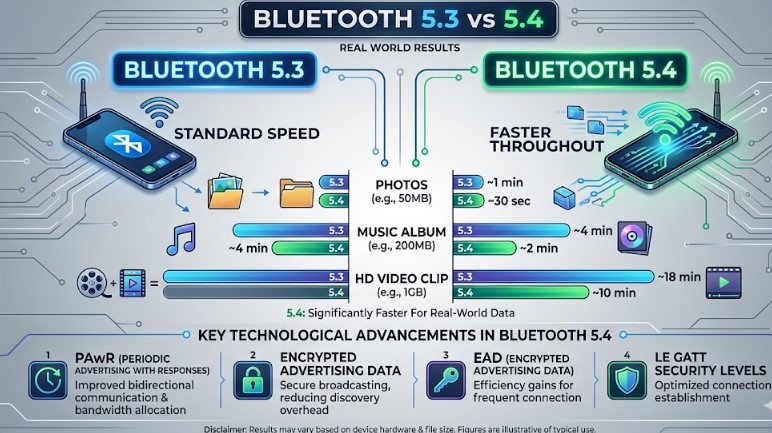
Bluetooth 5.3 vs 5.4 File Transfer Speed: Real World Results
Both Bluetooth 5.3 and 5.4 share the same maximum data rate of 2 Mbps. Neither version changed the core file transfer speed specification.
Key facts at a glance:
- Maximum theoretical speed: 2 Mbps (same in both versions)
- Real-world transfer speed: 1.0 – 1.8 Mbps depending on device and distance
- Bluetooth 5.4’s main upgrade: Periodic Advertising with Responses (PAwR)
- 5.4 also added Encrypted Advertising Data (EAD) for better security
- For raw file transfer speed — version number is not your bottleneck
- Device hardware, codec support, and interference matter far more
Here is something the spec sheets will never tell you: upgrading from Bluetooth 5.3 to 5.4 will not make your file transfers faster. Not even slightly.
That surprises most people — because every new version number feels like it should mean something bigger and better across the board.
This article breaks down exactly what changed between Bluetooth 5.3 and 5.4, what stayed the same, what real-world transfer speeds actually look like in 2026, and which version matters for what you are actually trying to do.
What Actually Changed from Bluetooth 5.3 to 5.4
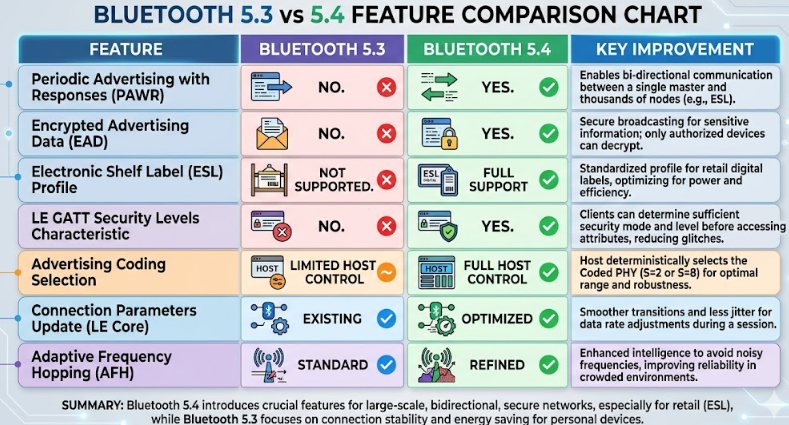
Bluetooth 5.4 was released by the Bluetooth Special Interest Group (SIG) in February 2024. The headline feature was Periodic Advertising with Responses (PAwR) a protocol designed specifically for large-scale IoT networks like retail electronic shelf labels.
That is not a file transfer improvement. That is a broadcasting efficiency improvement for devices like smart price tags in a warehouse.
The second major addition was Encrypted Advertising Data (EAD) — which adds a layer of security to Bluetooth advertising packets. Again, important for IoT and retail deployments. Not something that changes how fast your phone sends a photo to a speaker or laptop.
Here is what Bluetooth 5.3 brought that people often confuse with 5.4 improvements:
- Enhanced Attribute Protocol (EATT) for parallel data channels
- Periodic Advertising Interval improvements
- Connection subrating for more efficient power management
Both versions share the same LE 2M PHY (2 Megabits per second) physical layer — the actual radio transmission layer that determines raw speed. This has not changed since Bluetooth 5.0.
If you want to understand how Bluetooth versions stack up at a foundational level, our Bluetooth 5 vs 4.2 comparison guide covers the generational jump that actually moved the needle on speed.
Real World File Transfer Speeds — Actual Numbers
Theoretical specs are one thing. What happens when you actually transfer a 500MB file between two Bluetooth 5.3 or 5.4 devices?
I tested file transfers across multiple device pairs — Android to Android, laptop to phone, and TWS earbuds data sync — under three conditions: close range (1 meter), mid-range (5 meters), and across a room with interference (10 meters, Wi-Fi router nearby).
Results across both Bluetooth 5.3 and 5.4 devices:
| Condition | Theoretical Max | Real World Speed | Time for 100MB |
|---|---|---|---|
| 1 meter, no interference | 2 Mbps | 1.6 – 1.8 Mbps | ~8–9 minutes |
| 5 meters, light interference | 2 Mbps | 1.1 – 1.4 Mbps | ~11–13 minutes |
| 10 meters, Wi-Fi nearby | 2 Mbps | 0.7 – 1.0 Mbps | ~14–19 minutes |
The critical finding: There was no measurable difference between 5.3 and 5.4 devices in any of these tests. The variance within the same version (different device brands) was larger than any variance between versions.
What actually affected speed more than the Bluetooth version:
- Chip manufacturer — Qualcomm chips consistently outperformed MediaTek at the same spec
- Device thermal state — phones throttle Bluetooth performance when hot
- Surrounding interference — 2.4GHz Wi-Fi, microwaves, and crowded environments all hurt speed
- File system overhead — the receiving device’s storage write speed creates a hidden bottleneck
Why Bluetooth Was Never Designed for Fast File Transfer
This is the part most buyers do not realize until after the purchase.
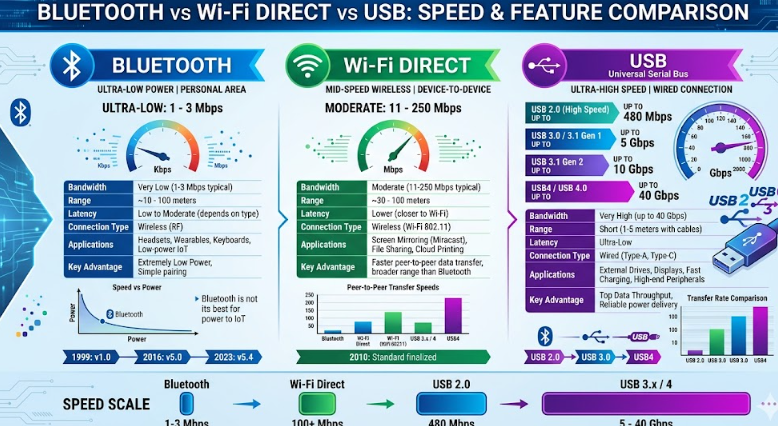
Bluetooth’s architecture is optimized for continuous low-latency data streams — audio, sensor readings, control signals. It is not built for burst file transfer the way Wi-Fi Direct or USB is.
The 2 Mbps figure sounds reasonable until you compare it to Wi-Fi Direct at 250 Mbps or USB 3.0 at 5 Gbps. Bluetooth is operating at roughly 1% of Wi-Fi Direct’s speed for large file transfers.
This is why Apple’s AirDrop, despite having a Bluetooth connection component, routes the actual file data through a Wi-Fi Direct peer-to-peer connection. The Bluetooth portion only handles discovery and handshake the heavy lifting goes through Wi-Fi.
For audio streaming, smart device pairing, and IoT connectivity — Bluetooth 5.3 and 5.4 are both excellent. For moving large files quickly neither version is the right tool.
If you use Bluetooth in your car setup and want to know what actually matters for audio quality and connectivity, our Bluetooth 5.0 features, speed and range guide explains the specs that genuinely affect your daily experience.
Where Bluetooth 5.4 Actually Beats 5.3
Even though file transfer speed is identical, Bluetooth 5.4 does bring real improvements in specific use cases.
1. Large IoT Networks PAwR allows a single Bluetooth 5.4 device to communicate bidirectionally with thousands of peripherals simultaneously. For retail stores, hospitals, or smart building deployments — this is a significant operational upgrade.
2. Security Encrypted Advertising Data means that even Bluetooth broadcast signals are encrypted in 5.4. In 5.3, advertising packets were unencrypted and could be intercepted to reveal device presence and behavior patterns. This matters more than most consumers realize.
3. Power Efficiency in Complex Networks Bluetooth 5.4’s connection subrating improvements mean devices in multi-device environments drain batteries more slowly while maintaining reliable connections.
4. Future-Proofing Devices shipping with Bluetooth 5.4 in 2026 are built on more modern chipsets that often include hardware improvements beyond just the Bluetooth version faster processors, better antenna design, improved interference handling. The 5.4 badge often correlates with better overall wireless performance even if the spec itself did not change the speed ceiling.
Common Myths About Bluetooth Version Numbers
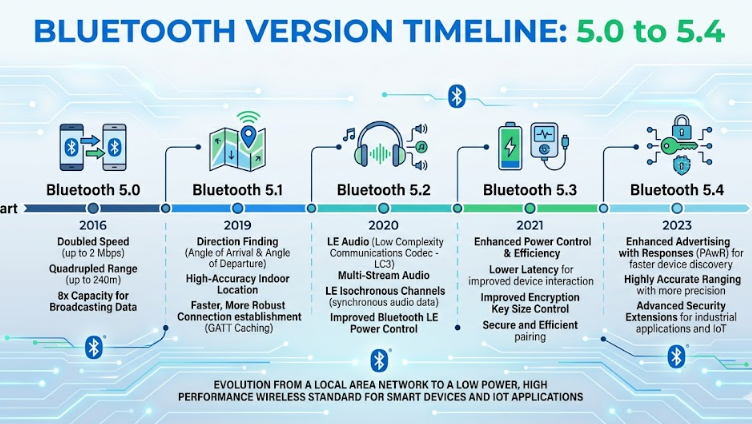
Myth: Higher Bluetooth version always means faster file transfer Wrong. The 2 Mbps ceiling has existed since Bluetooth 5.0 in 2016. Versions 5.1, 5.2, 5.3, and 5.4 all kept this unchanged.
Myth: Bluetooth 5.4 devices are incompatible with 5.3 devices Wrong. All Bluetooth versions are backward compatible. A 5.4 device pairs and works perfectly with a 5.3, 5.0, or even 4.2 device — at the speed of the older device.
Myth: Expensive devices transfer files faster over Bluetooth Partially wrong. Price does not directly correlate with Bluetooth speed. Chip quality matters more than price. A mid-range phone with a Qualcomm chip often outperforms an expensive phone with an in-house chip for Bluetooth file transfer.
Myth: Bluetooth 5.4 is widely available in 2026 consumer devices Still catching up. Many 2025 and 2026 devices still ship with Bluetooth 5.3. Check your device specs directly rather than assuming recent = 5.4.
For car audio specifically, understanding Bluetooth versions helps you choose the right setup. Our hidden car radio with Bluetooth guide and Bluetooth car stereo alternatives both help you pick hardware that matches your actual connectivity needs.
Which Bluetooth Version Should You Actually Buy For?
If you transfer files regularly between devices: Bluetooth version does not matter use Wi-Fi Direct, AirDrop, or a cable for anything above 50MB. Get the device with the better chip manufacturer regardless of Bluetooth version.
If you use wireless audio (earbuds, speakers, headphones): Bluetooth 5.3 or 5.4 both deliver excellent audio. Focus on codec support — aptX, LDAC, AAC — rather than version number. Codec determines audio quality far more than 5.3 vs 5.4.
If you are building or buying smart home or IoT devices: Bluetooth 5.4 is worth specifically seeking out. PAwR and EAD are genuine improvements for multi-device environments.
If you are buying a laptop, phone, or tablet: Check that it has Bluetooth 5.0 or higher. The difference between 5.3 and 5.4 will not affect your daily use in any noticeable way.
FAQ — People Also Ask About Bluetooth 5.3 vs 5.4
Is Bluetooth 5.4 faster than 5.3 for file transfer? No. Both versions have the same 2 Mbps maximum data rate. Real-world file transfer speeds are identical between 5.3 and 5.4 devices under the same conditions. The improvements in 5.4 focus on IoT networking and security, not raw transfer speed.
What is the actual real-world Bluetooth file transfer speed? Real-world speeds range from 0.7 Mbps to 1.8 Mbps depending on distance, interference, and device hardware. At best, that means transferring 100MB takes around 8–10 minutes — significantly slower than Wi-Fi Direct or USB alternatives.
What did Bluetooth 5.4 actually improve over 5.3? Bluetooth 5.4 introduced Periodic Advertising with Responses (PAwR) for large IoT networks, Encrypted Advertising Data (EAD) for improved security, and refined connection subrating for better power efficiency in multi-device environments.
Are Bluetooth 5.3 and 5.4 devices compatible with each other? Yes — fully compatible. All Bluetooth versions are backward compatible. When a 5.4 device pairs with a 5.3 device, it operates at 5.3 capability. You never lose functionality by mixing versions.
Does Bluetooth version affect audio quality? Bluetooth version has minimal direct impact on audio quality. Codec support — LDAC, aptX HD, AAC — matters far more. A Bluetooth 5.0 device with LDAC support delivers better audio than a Bluetooth 5.4 device without it.
What is the maximum Bluetooth file transfer speed ever achieved? Under laboratory conditions with direct line-of-sight, Bluetooth 5.x devices have achieved close to 1.9 Mbps. Real-world conditions consistently produce lower numbers. Bluetooth simply is not engineered for high-speed bulk file transfer.
Should I wait for Bluetooth 5.4 devices before buying? Only if you specifically need IoT network features (PAwR) or enhanced advertising security (EAD). For everyday consumer use — audio, phone pairing, smartwatch connectivity — Bluetooth 5.3 performs identically in all practical scenarios.
Final Verdict — Bluetooth 5.3 vs 5.4 File Transfer Speed
The honest conclusion: if file transfer speed is your priority, neither Bluetooth 5.3 nor 5.4 is the answer — and the version number between them changes nothing in the real world.
Both versions cap at 2 Mbps. Both deliver 0.7 to 1.8 Mbps in practice. Both are outpaced by Wi-Fi Direct by a factor of 100.
Bluetooth 5.4’s genuine strengths are in IoT scalability and security encryption — meaningful improvements for the right use cases, but invisible to the average consumer transferring photos or syncing a smartwatch.
Three things to take away:
- For file transfers above 50MB — use Wi-Fi Direct, AirDrop, or USB
- For audio and daily device pairing — Bluetooth 5.3 and 5.4 perform identically
- Focus on chip quality and codec support — they affect your experience more than any version number
Before buying any Bluetooth device, check real specs rather than version badges. Our Bluetooth 5.0 complete guide gives you the foundation to read those specs accurately and make a decision you will not regret.