
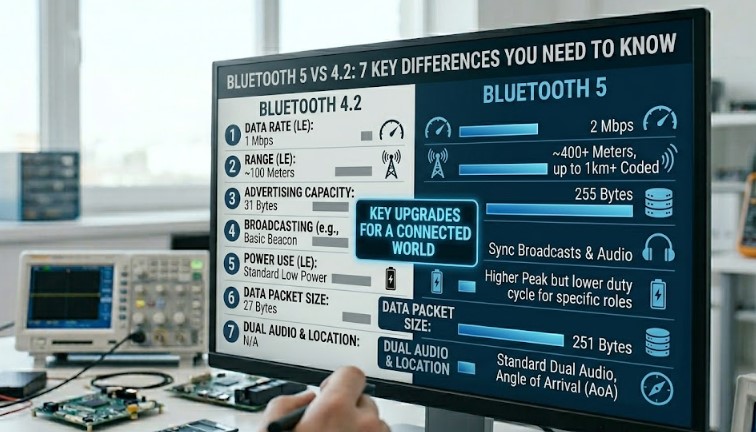
Bluetooth 5 vs 4.2: 7 Key Differences You Need to Know
Here’s the truth nobody tells you: Most people are still using outdated Bluetooth and they don’t even know it.
If you’ve ever asked yourself, “Why does my wireless speaker keep cutting out?” or “Why can’t I connect two Bluetooth devices at the same time?” you’re not alone. Millions of users face these frustrations daily, and the answer almost always comes down to one thing: Bluetooth version. The difference between Bluetooth 5 and Bluetooth 4.2 isn’t just a number. It’s the difference between a seamless smart home experience and a choppy, drop-prone connection that drives you crazy. It’s the gap between a fitness tracker that updates in real time and one that lags behind by seconds.
Understanding the Bluetooth Standard What Does the Version Number Actually Mean?
What Is Bluetooth and Why Do Versions Matter?
Bluetooth is a short-range wireless communication technology that allows devices to exchange data without cables. It runs on the 2.4 GHz radio frequency band and is governed by the Bluetooth Special Interest Group (SIG) a global consortium of over 35,000 member companies.
Every few years, the Bluetooth SIG releases a new version of the Bluetooth Core Specification. Each version brings improvements in speed, range, power consumption, and features. The version number like 4.2 or 5 tells you which specification your device supports.
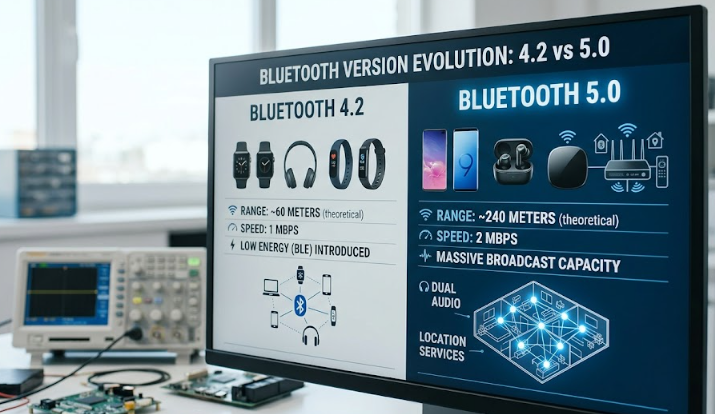
But here’s what most people get wrong: not all Bluetooth upgrades are created equal. Some versions, like Bluetooth 5, introduced radical improvements. Others were minor refinements. Understanding what changed between 4.2 and 5 is critical if you want to make smart purchasing decisions.
A Brief History of Bluetooth Versions
- Bluetooth 1.0 (1999): The beginning. Extremely limited range, slow speeds, and lots of compatibility issues.
- Bluetooth 2.0 + EDR (2004): Introduced Enhanced Data Rate, tripling speeds to 3 Mbps.
- Bluetooth 3.0 + HS (2009): Added high-speed data transfer using Wi-Fi as a secondary channel.
- Bluetooth 4.0 (2010): Revolutionary. Introduced Bluetooth Low Energy (BLE), enabling IoT devices and wearables to operate for months on a coin cell battery.
- Bluetooth 4.1 (2013): Improved coexistence with LTE and added better device reconnection.
- Bluetooth 4.2 (2014): Enhanced privacy, improved BLE speed, and added IPv6 support — enabling direct internet connectivity for IoT devices.
- Bluetooth 5.0 (2016): A massive leap. Doubled speed, quadrupled range, increased broadcasting capacity 8x.
- Bluetooth 5.1 (2019): Added direction finding (precise indoor positioning).
- Bluetooth 5.2 (2020): Introduced LE Audio and LC3 codec — transforming wireless audio quality.
- Bluetooth 5.3 (2021): Improved efficiency and reduced power consumption further.
- Bluetooth 5.4 (2023): Added Periodic Advertising with Responses (PAwR) for large-scale IoT deployments.
As you can see, Bluetooth 4.2 and Bluetooth 5 represent two distinct eras in wireless technology. Let’s break down exactly what changed.
Who Uses Bluetooth 4.2 vs Bluetooth 5 Today?
Bluetooth 4.2 users typically include:
- People with devices purchased before 2018
- Users of older fitness trackers (Fitbit Charge 2, early Garmin devices)
- Budget smartphones from 2016–2019
- Older smart home sensors and hubs
Bluetooth 5 users typically include:
- Anyone with a smartphone released after 2018 (iPhone 8 and later, Samsung Galaxy S8 and later)
- Modern wireless earbuds (AirPods Pro, Samsung Galaxy Buds, Sony WF-1000XM5)
- Smart home devices with real-time communication needs
- Professional audio equipment
- Advanced IoT networks
The adoption curve has been steep. By 2023, over 60% of all Bluetooth-enabled devices shipped globally supported Bluetooth 5 or higher, according to the Bluetooth SIG’s annual market report.
Why This Comparison Matters in 2025
In 2025, Bluetooth 5 is the baseline standard for new devices. But millions of Bluetooth 4.2 devices are still in active use worldwide. Understanding the difference between the two helps you:
- Decide whether to upgrade your current devices
- Troubleshoot connectivity issues you’re already experiencing
- Make smarter choices when buying new tech
- Understand the limitations of your existing smart home setup
- Plan for future-proof investments in wireless technology
Now, let’s get into the real meat of this comparison — the technical specifications.
Technical Specifications — Bluetooth 5 vs 4.2 Head to Head
Speed Comparison — How Much Faster Is Bluetooth 5?
Speed in Bluetooth is measured as data throughput — how much data can be transmitted per second.
Bluetooth 4.2:
- Maximum data rate: 1 Mbps (in LE mode)
- Actual throughput (real-world): approximately 0.27 Mbps
- This speed is sufficient for simple sensor data, basic audio streaming, and short messages
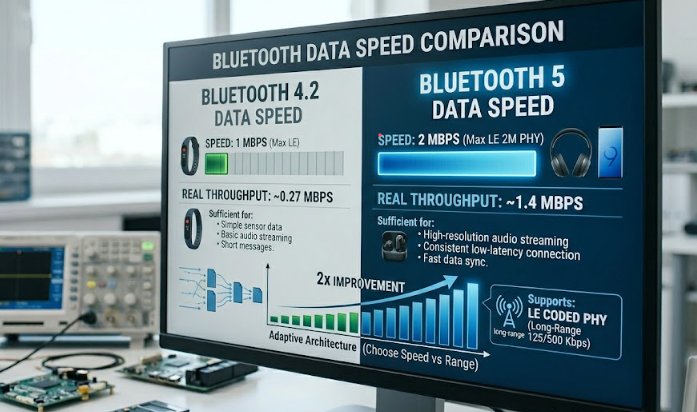
Bluetooth 5:
- Maximum data rate: 2 Mbps (in LE 2M PHY mode)
- Actual throughput (real-world): approximately 1.4 Mbps in optimal conditions
- Also supports LE Coded PHY (125 Kbps or 500 Kbps) — a slower but extremely long-range mode
That’s a 2x improvement in maximum speed. But it’s not just about raw throughput. Bluetooth 5’s architecture is smarter — it can adaptively choose between high-speed and long-range modes depending on what the application needs.
Real-world example: Streaming high-quality audio from your phone to wireless headphones requires consistent, low-latency data transfer. With Bluetooth 4.2, you might experience micro-dropouts during intensive phone activity. With Bluetooth 5, the 2 Mbps pipe provides enough headroom to maintain smooth audio even under load.
Range Comparison How Much Further Can Bluetooth 5 Reach?
Bluetooth 4.2:
- Indoor range: approximately 10–30 meters (practical)
- Outdoor range: up to 60 meters (line of sight, ideal conditions)
Bluetooth 5:
- Indoor range: approximately 40–100 meters (practical)
- Outdoor range: up to 240 meters (line of sight, ideal conditions)
- In LE Coded PHY mode (long-range): theoretically up to 400+ meters outdoors
That’s a 4x improvement in theoretical range — and a significant real-world improvement as well.
Why does range matter?
For consumers, it means your wireless headphones won’t cut out when you walk to the kitchen while your phone is in the living room. For smart home users, it means sensors in your garage or garden can reliably communicate with a central hub inside your home. For industrial IoT deployments, it means fewer access points needed to cover a large facility — saving significant infrastructure costs.
Important caveat: Range is always affected by environmental factors — walls, interference from other 2.4 GHz devices (Wi-Fi routers, microwaves), and physical obstructions. The theoretical maximums are achieved in perfect laboratory conditions. Real-world performance will vary, but the relative advantage of Bluetooth 5 remains consistent.
Broadcast Capacity The Hidden Superpower of Bluetooth 5
This is the most underappreciated improvement in Bluetooth 5, and it’s critically important for IoT applications.
Bluetooth uses advertising packets to broadcast information without establishing a full connection. This is how beacons work, how fitness trackers broadcast step data, and how proximity sensors communicate.
Bluetooth 4.2:
- Advertising packet payload: 31 bytes
- Extended advertising: not supported
Bluetooth 5:
- Advertising packet payload: 255 bytes (8x more data per packet)
- Extended advertising: supported (up to 1,650 bytes per advertising event)
- Periodic advertising: supported (synchronized broadcasting to multiple devices)
This 8x increase in broadcasting capacity is transformative for certain use cases:
- Retail beacons can now send rich product information directly to passing customers’ phones without requiring them to open an app or establish a connection
- Asset tracking tags can include detailed location and status data in a single broadcast
- Smart building sensors can transmit complex environmental data without power-hungry connection establishment
- Digital signage can push content information to nearby devices efficiently
Comparison Table — Bluetooth 5 vs 4.2 Key Specs
| Feature | Bluetooth 4.2 | Bluetooth 5 | Improvement |
| Maximum Speed | 1 Mbps | 2 Mbps | 2x faster |
| Range (Outdoor) | 60 meters | 240 meters | 4x longer |
| Broadcast Capacity | 31 bytes | 255 bytes | 8x more |
| Channels | 3 advertising channels | 40 channels (flexible) | More efficient |
| Dual Audio | No | Yes | New feature |
| Direction Finding | No | Yes (5.1+) | New feature |
| LE Audio (LC3) | No | Yes (5.2+) | New feature |
| IPv6 Support | Yes | Yes | Maintained |
| Coexistence with Wi-Fi | Good | Excellent | Improved |
| Typical Power Draw | Low | Lower | More efficient |
| Backward Compatible | Yes | Yes | Maintained |
Power Consumption — Battery Life and Energy Efficiency
In the era of wearables and IoT, battery life is king. A smartwatch that needs charging every day is an inconvenience. A medical monitoring sensor that dies unexpectedly is a potential safety hazard. Power consumption is one of the most critical real-world differentiators between Bluetooth versions.
Bluetooth Low Energy (BLE) — introduced in Bluetooth 4.0 was already dramatically more efficient than classic Bluetooth. Both Bluetooth 4.2 and Bluetooth 5 use BLE. But Bluetooth 5 takes efficiency further.
How Bluetooth 5 Reduces Power Consumption
Bluetooth 5 introduces several architectural improvements that reduce power draw:
1. Faster Data Transfer = Less Radio-On Time Because Bluetooth 5 can transmit data at 2 Mbps (vs 1 Mbps for 4.2), it completes data transfers in half the time. The radio can power down sooner, saving energy.
2. Smarter Advertising Bluetooth 5’s extended and periodic advertising modes allow devices to pack more information into fewer transmissions. This means the radio activates less frequently — a major battery saver for devices that primarily broadcast data (sensors, beacons, trackers).
3. LE Coded PHY This long-range mode trades speed for extreme range. While it uses more power than standard BLE when active, it allows devices to maintain connections over much greater distances, potentially eliminating the need for signal repeaters — which saves system-level power.
4. Improved Scheduling Bluetooth 5 has better mechanisms for scheduling connection events, reducing unnecessary wake-ups and idle listening periods.
Real-World Battery Life Examples
Fitness Tracker (Bluetooth 4.2):
- Typical battery life: 5–7 days
- Syncs every 15 minutes during active use
- Connection drops if phone is more than ~30 feet away, triggering repeated reconnection attempts (wasting power)
Fitness Tracker (Bluetooth 5):
- Typical battery life: 7–14 days (same physical battery)
- Syncs more efficiently with larger data packets
- Maintains stable connection at greater distances, eliminating wasteful reconnection cycles
Smart Home Sensor (Bluetooth 4.2):
- Temperature/humidity sensor: battery lasts approximately 6–12 months on a CR2032 coin cell
- Limited range requires placement near the hub
Smart Home Sensor (Bluetooth 5):
- Same sensor type: battery can last 12–24 months
- Greater range allows placement anywhere in the home without additional repeaters
The Power vs Range Trade-off in Bluetooth 5
Bluetooth 5’s LE Coded PHY mode is fascinating because it deliberately trades speed for range at the cost of higher power consumption while the radio is active. This seems counterintuitive, but it’s actually brilliant for specific use cases.
A livestock tracking tag on a farm, for example, needs to work over hundreds of meters but transmits very little data very infrequently. Using LE Coded PHY, the tag can maintain connection with a base station hundreds of meters away, transmit its location once per minute, and still last for months on a small battery because even though each transmission uses more power, those transmissions are rare.
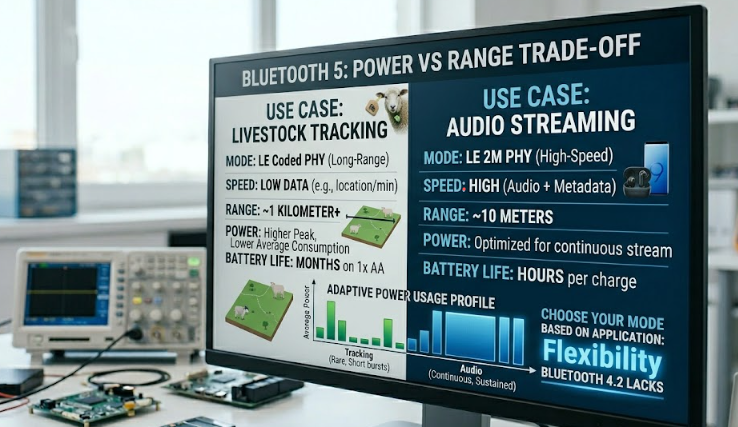
This flexibility choose your mode based on your application is one of Bluetooth 5’s most powerful features that Bluetooth 4.2 simply cannot match.
IoT and Smart Home Applications
The Internet of Things Revolution and Bluetooth’s Role
The Internet of Things (IoT) refers to the network of physical devices from smart lightbulbs to industrial sensors to medical devices that collect and exchange data over the internet or local networks. By 2025, the global IoT market has grown to include over 15 billion connected devices, and Bluetooth is at the heart of much of this ecosystem.
Why Bluetooth? Because it offers:
- Low power consumption (devices can run on batteries for months or years)
- No subscription fees (unlike cellular IoT)
- Universal adoption (every smartphone supports it)
- Short-to-medium range (perfect for home and building automation)
But as IoT grew more sophisticated, Bluetooth 4.2 began showing its limits. Enter Bluetooth 5.
How Bluetooth 5 Transforms Smart Home Setups
Scenario 1: The Multi-Room Smart Home
With Bluetooth 4.2, achieving full coverage in a multi-story home often required multiple hubs or mesh networking devices placed strategically to relay signals. The limited range meant that sensors in a basement, an attic, or a detached garage simply couldn’t reliably communicate with a central hub.
With Bluetooth 5’s 4x range improvement, a single hub placed centrally can cover a much larger area. This reduces cost, complexity, and the number of devices that need to be powered and maintained.
Scenario 2: The Smart Retail Environment
Retailers use Bluetooth beacons to deliver personalized offers, navigate customers through stores, and track inventory. With Bluetooth 4.2’s 31-byte advertising limit, beacons could only send a simple ID — the phone would then need to look up the associated content from a server, adding latency.
With Bluetooth 5’s 255-byte (and up to 1,650-byte extended) advertising, beacons can include rich content directly in the broadcast — no server lookup required. Faster, more reliable, and more engaging for customers.
Scenario 3: Industrial Asset Tracking
A hospital needs to track the real-time location of medical equipment — wheelchairs, infusion pumps, portable monitors. With Bluetooth 4.2, tracking required dense placement of readers every 10–20 meters. With Bluetooth 5 and its direction-finding capability (introduced in 5.1), precise indoor positioning can be achieved with fewer, more widely spaced infrastructure points.
Audio Codecs — The Real Determinant of Sound Quality
Codecs compatible with Bluetooth 4.2:
- SBC (Subband Coding): The mandatory baseline codec. Works on all devices but offers relatively low audio quality (~328 Kbps, lossy compression)
- AAC (Advanced Audio Coding): Apple’s preferred codec. Better quality than SBC, supported on iPhones and many Android devices
- aptX: Qualcomm’s codec offering CD-like quality (~352 Kbps). Requires both devices to support it
- aptX HD: Higher-quality version (~576 Kbps) — pushes against Bluetooth 4.2’s bandwidth limits
- LDAC: Sony’s high-resolution audio codec (up to 990 Kbps) — actually stresses Bluetooth 4.2’s 1 Mbps limit significantly
Codecs enabled or enhanced by Bluetooth 5:
- All of the above, with more headroom
- LC3 (Low Complexity Communication Codec): Introduced with Bluetooth 5.2’s LE Audio. This codec delivers better quality than SBC at half the bitrate — a revolutionary improvement in efficiency
- LC3plus: An enhanced version for professional audio applications
- aptX Lossless: Qualcomm’s lossless audio codec, capable of transmitting CD-quality audio without any compression artifacts — only possible with Bluetooth 5’s higher bandwidth
LE Audio — The Game Changer in Bluetooth 5.2
- LC3 codec — better quality at lower bitrates
- Multi-stream audio — independent left and right audio streams, dramatically improving stereo accuracy and reducing latency
- Broadcast Audio / Auracast — one device can broadcast audio to unlimited receivers simultaneously (imagine a TV in a gym broadcasting directly to everyone’s earbuds, or an airport announcement going to all passengers’ hearing aids)
- Hearing aid support — standardized, open platform for hearing aids to connect with any LE Audio device
This is a paradigm shift. Bluetooth 4.2 devices simply cannot access any of these features. LE Audio is exclusively a Bluetooth 5.2+ feature.
Latency — The Hidden Audio Quality Factor
Audio latency refers to the delay between the audio source and what you hear. High latency is the reason your voice sounds echo-y when you wear wireless headphones during a video call, or why gaming audio doesn’t match the on-screen action.
Bluetooth 4.2 latency:
- SBC: 100–200ms (noticeable, disruptive for gaming and video)
- aptX: ~40ms (good)
- aptX Low Latency: ~32ms (very good, but requires specific hardware support)
Bluetooth 5 latency:
- With LC3 (LE Audio): as low as 7.5ms — essentially imperceptible
- With Multi-Stream: independent streams for left and right reduce sync issues
- Overall: significantly lower latency ceiling, though actual performance depends on device implementation
For gamers, video editors, musicians, and video call users, this latency improvement alone justifies upgrading to Bluetooth 5 devices.
Section 6: Security — Is Bluetooth 5 More Secure Than 4.2?
The Bluetooth Security Landscape
Bluetooth security has historically been a concern. Over the years, various vulnerabilities have been discovered and exploited from simple eavesdropping to full device takeover attacks like BIAS (Bluetooth Impersonation Attacks) and BlueBorne.
Both Bluetooth 4.2 and Bluetooth 5 include significant security features, but there are meaningful differences in their security architectures.
Bluetooth 4.2 Security Features
Bluetooth 4.2 introduced several important security improvements over earlier versions:
LE Secure Connections:
- Uses Elliptic Curve Diffie-Hellman (ECDH) key exchange for pairing
- Provides protection against passive eavesdropping and man-in-the-middle attacks
- Significantly stronger than the simple XOR-based pairing of earlier versions
Enhanced Privacy:
- Introduced Resolvable Private Addresses (RPA) — devices can regularly change their Bluetooth address to prevent tracking by third parties
- Only trusted, paired devices can resolve the address back to the device’s true identity
IPv6 and 6LoWPAN Support:
- Enabled direct internet connectivity for BLE devices, but also introduced new security surface areas that needed to be managed carefully
AES-128 Encryption:
- All communication can be encrypted using AES-128, the same encryption standard used by many banking applications
Despite these features, Bluetooth 4.2 still had vulnerabilities. The KNOB (Key Negotiation of Bluetooth) attack, disclosed in 2019, affected many Bluetooth Classic implementations and some BLE scenarios. Various implementation flaws in device firmware also created exploitable weaknesses.
Bluetooth 5 Security Improvements
Bluetooth 5 builds on the security foundation of 4.2 and addresses several known weaknesses:
Improved Key Derivation:
- Enhanced key derivation functions make brute-force attacks significantly more difficult
- Cross-transport key derivation improvements reduce the attack surface when devices support both BR/EDR (Classic) and LE
Extended Advertising Security:
- Bluetooth 5’s extended advertising channels include better authentication mechanisms
- Reduces the risk of fake beacon attacks (where malicious devices broadcast deceptive information)
Better Implementation Guidelines:
- The Bluetooth SIG published significantly more detailed implementation guidelines alongside the Bluetooth 5 specification
- This has led to fewer implementation errors in device firmware — historically a major source of real-world vulnerabilities
Forward Secrecy:
- Bluetooth 5 devices can implement perfect forward secrecy more effectively, ensuring that even if a session key is compromised, past sessions remain protected
Device Ecosystem — Which Devices Support Bluetooth 5?
Smartphones and Tablets
Bluetooth 5 became standard in flagship smartphones starting in 2017–2018:
Apple:
- iPhone 8 and later: Bluetooth 5.0
- iPad Pro (2018 and later): Bluetooth 5.0
- AirPods Pro (2nd gen, 2022): Bluetooth 5.3
Samsung:
- Galaxy S8 (2017): First Samsung flagship with Bluetooth 5.0
- Galaxy S21 series and later: Bluetooth 5.2
- Galaxy S24 series: Bluetooth 5.3
Google:
- Pixel 3 (2018): Bluetooth 5.0
- Pixel 6 series: Bluetooth 5.2
- Pixel 8 series: Bluetooth 5.3
Budget Android Phones:
- Most devices under $150 released before 2020 still use Bluetooth 4.2
- As of 2023–2025, even many budget devices include Bluetooth 5.0
Frequently Asked Questions (FAQ)
Most Common Questions About Bluetooth 5 vs 4.2
Q1: Is Bluetooth 5 compatible with Bluetooth 4.2 devices?
Yes, completely. Bluetooth is designed to be backward compatible. A Bluetooth 5 device (like a new smartphone) will connect and work with Bluetooth 4.2 devices (like older headphones). However, the connection will operate at Bluetooth 4.2 capabilities — you won’t get Bluetooth 5’s speed, range, or feature improvements when connected to a 4.2 device.
Q2: Can I upgrade my device from Bluetooth 4.2 to Bluetooth 5 with a software update?
No. Bluetooth version is determined by the hardware radio chip inside your device. Software updates cannot change the hardware. If your device has a Bluetooth 4.2 chip, it will always be Bluetooth 4.2 regardless of software updates. The only way to get Bluetooth 5 is to buy a new device with Bluetooth 5 hardware.
Q3: How much faster is Bluetooth 5 than 4.2 in real use?
Bluetooth 5’s maximum data rate is 2 Mbps vs 4.2’s 1 Mbps — double the theoretical speed. In real-world use, the improvement depends on the application. For audio streaming, the difference is more about quality ceiling (Bluetooth 5 can handle higher-quality codecs) than perceived speed. For IoT data transfer, Bluetooth 5 can complete the same data exchange in roughly half the time, then power down the radio sooner — saving battery.
Q4: Will Bluetooth 5 headphones work better with a Bluetooth 4.2 phone?
Not significantly. When Bluetooth 5 headphones connect to a Bluetooth 4.2 phone, the connection operates at Bluetooth 4.2 capability. You won’t get the extended range or higher bandwidth of Bluetooth 5. However, the headphones themselves may have better audio hardware, noise cancellation, and firmware than older models — so they might sound better even on a Bluetooth 4.2 connection because of the headphones’ internal improvements, not the Bluetooth version.
Your Next Steps
If you’re buying a new smartphone today: Don’t settle for anything less than Bluetooth 5.0. Every major Android and iOS device released since 2018 includes it — if you’re seeing a new phone advertised without Bluetooth 5, look harder or look elsewhere.
If you’re building a smart home: Start with Bluetooth 5-capable hubs and gateways. Add peripheral devices gradually, prioritizing Bluetooth 5 for range-critical and battery-critical applications.
If you’re upgrading audio equipment: Look for Bluetooth 5.2+ devices with LC3 and LE Audio support, especially if low latency for gaming or precise stereo imaging for music are priorities.
If you’re making industrial or commercial IoT investments: Bluetooth 5 isn’t optional — the improvements in range, broadcast capacity, and battery life deliver measurable ROI in reduced infrastructure costs and extended maintenance cycles.
If you’re a developer or engineer: Familiarize yourself with the Bluetooth 5 Core Specification, particularly the LE Audio, LE Coded PHY, and Extended Advertising specifications. These are the features that will define the next decade of wireless applications.
The wireless world has moved on. Bluetooth 5 isn’t the future — it’s the present. And for anyone still tethered to the limitations of Bluetooth 4.2, the upgrade path has never been more clear, more affordable, or more impactful.
Make the switch. Your devices and your sanity will thank you.